Quick answer: Carbon fiber doesn’t dent and pop back like sheet metal. An impact can leave a surface indentation, but it can also crack the resin matrix, break fibers, or separate laminate layers (delamination) with little visible sign. Cosmetic clear-coat damage can often be refinished. Anything that reaches the laminate — or any damage on a load-bearing part — needs a proper inspection before you decide between repair and replacement.
Can Carbon Fiber Actually Be Dented or Popped Out?
Sheet metal deforms plastically under impact — it stretches, and the dent stays because the metal has no way to spring back on its own. This is also why paintless dent repair (pulling or pushing metal back into shape) works on cars in the first place.
Carbon fiber reinforced plastic (CFRP) is a cured composite laminate, not a ductile sheet. It doesn’t respond to impact the same way, and it cannot be “popped out” with metal dent-pulling tools or techniques. When a CFRP part takes an impact, one or more of the following can happen instead:
- The clear coat or gel coat chips, scratches, or cracks, with the laminate underneath unaffected
- The resin matrix cracks without breaking the fibers
- Individual fibers break, which directly reduces the part’s load-carrying capacity in that area
- Adjacent plies separate from each other (delamination) — often with no clear visible sign
- On sandwich-core parts (foam or honeycomb core between laminate skins), the core crushes locally, which can look like a shallow surface “dent” while hiding more significant internal damage
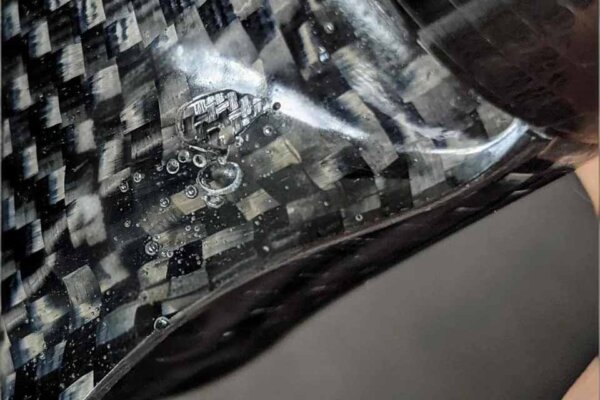
A visible depression on a carbon fiber part might mean nothing more than a scuffed clear coat. It might also mean the laminate underneath is structurally compromised. You can’t reliably tell which from looking at it — which is the core problem with treating this like a metal-dent question.
Cosmetic Damage vs. Structural Damage: What to Actually Check
Impact energy in a laminate tends to spread out between plies rather than staying concentrated at the point of contact, so a small, unremarkable-looking mark can sit above a much larger area of internal delamination. In aerospace and motorsport composites, this is well known enough to have its own name: Barely Visible Impact Damage (BVID) — damage that’s structurally real but not obvious to the eye.
Use this as a first screening step, not a final safety clearance:
| What you see or feel | Likely damage | Recommended action |
|---|---|---|
| Clear-coat scratch or chip, weave pattern looks unbroken | Cosmetic finish damage only | Clean, document, and ask a refinishing professional about a surface repair |
| Shallow surface depression, no cracking, panel still feels rigid | Possibly cosmetic, laminate likely intact | Have it inspected before sanding, filling, or continued structural use |
| White or cloudy patches near the impact, in a matte or lightly tinted finish | Resin cracking or fiber breakage | Get a professional inspection before continued use |
| Crack you can see or catch with a fingernail, splinters, exposed fibers | Laminate cracking, likely fiber breakage | Stop using the part; professional structural assessment required |
| Soft or spongy area, audible cracking, visible layer separation | Delamination or core crushing | Do not load the part; professional assessment required |
| Any of the above on a load-bearing or safety-relevant part (chassis component, structural bracket, bicycle frame, helmet, suspension part) | Severity uncertain without inspection | Do not return to service based on appearance; follow OEM or qualified inspection procedure |
A visual check can catch obvious warning signs. It cannot prove a laminate is structurally sound — a hand-pressure or “does it feel rigid” check is not a safety clearance for anything load-bearing. For structural parts, a qualified inspection typically uses tap testing, ultrasonic inspection, thermography, or another non-destructive testing (NDT) method matched to the part’s construction.
Documenting the damage properly helps whoever assesses it next. Photograph the area in good light, note the impact location and approximate size, record whether the part was under load when it happened, and check for cracks in the coating, discoloration, broken weave, or any change in surface contour.
What You Can Reasonably Do for Cosmetic Surface Damage
If — and only if — the part is non-structural and you’ve confirmed the laminate and fibers underneath are intact, a cosmetic refinish can restore appearance without touching the structural laminate. A typical scope looks like:
- Clean the area thoroughly, removing dirt, oil, and wax so nothing interferes with adhesion
- Prepare the surface with controlled, light abrasion — enough for the repair material to key in, not enough to damage the weave underneath
- Apply a compatible filler or clear-coat product, following its technical data sheet exactly for mix ratio, working time, and cure temperature
- Allow a full cure per the product’s specification — rushing this step is a common cause of poor cosmetic results
- Finish progressively, working through sandpaper grits before polishing and reclearing
This restores appearance. It does not reconnect broken fibers or restore load transfer across a delaminated area — so it should only be used where you’ve already established the damage is cosmetic-only.
Do not use a heat gun, metal dent-pulling tools, or drilling to “release” a dent in carbon fiber. Cured resin systems have a defined cure profile and glass transition temperature; uncontrolled local heating isn’t a controlled process and isn’t a reliable way to correct a laminate defect. Metal dent-pulling techniques don’t apply to a composite laminate. Sanding through the weave without a qualified repair procedure can turn a repairable defect into a worse one. A cosmetic fill can hide underlying damage — it does not fix it.
When You Need Professional Composite Inspection or Repair
Bring in a qualified composite repair specialist — not a general body shop, and not a DIY kit — when any of these apply:
- The part carries structural or safety-relevant load
- You see visible cracking, delamination, splinters, or exposed fibers
- There’s a soft, spongy, or crushed area
- The part was involved in a higher-energy impact, even if the visible mark looks minor
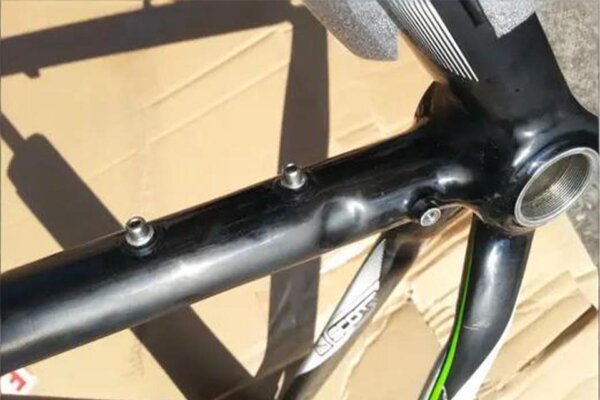
- The part is on a bicycle frame, helmet, vehicle chassis component, suspension part, or similar safety-critical application
How a Structural Composite Repair Actually Works
A qualified repair generally follows a process along these lines, though specifics vary with the part, laminate design, and resin system:
- Damage inspection — visual assessment plus an NDT method (tap testing, ultrasonic, or thermography) to map the real extent of delamination and fiber damage, which is often larger than the visible mark suggests
- Removal of damaged material — cutting back to sound laminate, typically as a scarf (tapered) or step joint so repair plies can transfer load smoothly into the surrounding structure
- Ply schedule for the repair — new carbon fiber plies selected and oriented to match the original laminate’s fiber orientation and layer count for that zone
- Lay-up — wet layup resin or prepreg material, depending on the shop’s process and the part’s requirements
- Consolidation and cure — vacuum bagging to remove trapped air and consolidate the plies; autoclave curing (heat plus pressure) where maximum strength and consistency are required
- Finishing — sanding, surface prep, and refinishing to blend the repair with the surrounding part
This is a fundamentally different scope of work than filling a surface depression, which is why structural repair is scoped, scheduled, and priced separately from cosmetic refinishing.
For aircraft, motorsport, bicycle frames, and other safety-critical components, the manufacturer’s approved repair procedure, engineering sign-off, and applicable regulations take precedence over any general guide — including this one.
Repair vs. Replacement
| Factor | Favors repair | Favors replacement |
|---|---|---|
| Damage extent | Localized, laminate can be fully inspected | Extensive delamination, multiple plies affected, or mold/core badly crushed |
| Part role | Non-structural or moderately loaded, with confirmed sound laminate | Safety-critical (chassis, suspension, frame, helmet) |
| Original construction | Known layup, reproducible with matching plies | Unknown layup, or original tooling/drawings unavailable |
| Finish complexity | Can be blended invisibly | Exposed weave, tight tolerance, or unusual geometry that’s hard to repair invisibly |
| Economics | Repair cost is clearly reasonable relative to part value | Repair cost approaches or exceeds a replacement part |
| Confidence | Inspection confirms the laminate is sound | Inspection can’t fully confirm internal condition |
For custom, low-volume, motorsport, or discontinued parts, replacement often comes down to whether a shop can actually reproduce the part accurately — not just whether the damage is repairable. That’s a different question from a standard repair-shop conversation, and it’s where working directly with a manufacturer matters.
What Affects Cost — and Why We Won’t Publish a Price Table
There’s no reliable universal price for “a carbon fiber dent.” Cost depends on:
- Whether the damage is cosmetic-only or extends into the laminate — the single biggest driver, since structural repair involves material removal, new ply lay-up, and controlled curing rather than surface filling
- Access to the damaged area, and whether the part needs to be removed to work on it
- Finish complexity — matching an exposed weave, specific gloss/matte finish, or paint color
- Whether the part is structural, which usually requires more rigorous process control and inspection sign-off
- Whether the part needs to be reverse-engineered from a sample, drawing, or scan rather than repaired at all
- Local labor rates and shop specialization
Generic price bands don’t reflect any of this, and a fixed number published on a page with no verified source is easy to misread as a quote. If you want an actual cost, send the part details for an itemized assessment rather than relying on a published range — see below.
Where This Kind of Damage Shows Up
Automotive and motorsport — carbon fiber car parts such as carbon fiber hoods, roof panels, spoilers, splitters, and diffusers see parking-lot contact and road debris; in racing, direct contact. This applies across platforms — including performance brands such as McLaren and Lamborghini where carbon fiber body panels are common — though the damage mechanics described here apply regardless of make or model. Cosmetic panels are often repairable or refinishable; structural components (splitters and underbody panels with real load paths, chassis-adjacent parts) need a proper damage assessment first.
Motorcycle — fairings, tank covers, and fenders are commonly damaged in low-speed drops. Most of this is cosmetic, but fairings with structural mounting points should be checked for cracking around fasteners.
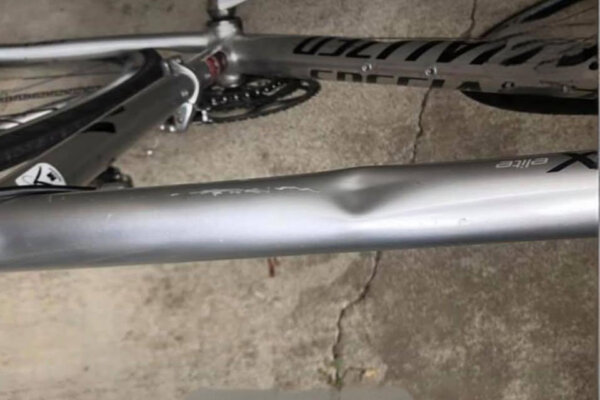
Sports and outdoor equipment — bicycle frames and helmets should generally be professionally inspected after any significant impact, given the consequences of an undetected structural failure.
Industrial equipment — carbon fiber housings, structural panels, and tubes are less exposed to casual impact but can suffer handling or transport damage that warrants inspection before a part goes back into service.
Aerospace — composite aircraft structures follow the manufacturer’s approved structural repair procedures and applicable aviation regulations, using NDT methods suited to the structure. This is background context, not a category most readers will be repairing themselves.
Preventing Impact Damage
- Paint protection film (PPF) on high-exposure areas such as leading edges, splitters, and lower panels can help reduce scratches, stone chips, and minor surface damage to the finish. It is not a substitute for careful handling and won’t stop significant impact energy from reaching the laminate underneath.
- Careful handling and storage — in practice, most damage comes from parts being knocked, dropped, or having tools leaned against them during maintenance, not dramatic collisions
- Avoiding extreme-temperature storage, since some resin systems can be affected by prolonged heat exposure
- Periodic visual inspection for early clear-coat cracking, UV-related discoloration, or stress marks near mounting points and fasteners, where loads concentrate
Request an Assessment or a Replacement Part
If a part isn’t a good repair candidate — or you’d simply rather have a new one made to the original specification — this is where a manufacturing conversation is more useful than a repair-shop one.
As a custom carbon fiber manufacturer, we work in prepreg autoclave molding, compression molding, vacuum infusion, and wet lay-up, selected according to the part’s structural requirements, finish, and production volume, along with CNC trimming, drilling, and bonding/assembly for finished parts. Our team can work from your existing damaged part as a reference, from CAD or STEP files, or from a 3D scan — see our engineering and manufacturing background for more on how projects like this are handled.
To get a useful response, send:
- Part name and application
- Photographs of the damage, in good light
- Outside dimensions and thickness, if known
- Mounting points and quantity needed
- Required finish
- Any available drawing or CAD file
We’ll confirm whether the right next step is a cosmetic finish repair, a referral for professional composite assessment, or a custom carbon fiber replacement part — including for one-off or low-volume runs where reordering from an OEM isn’t practical.
Frequently Asked Questions
Can you pop out a carbon fiber dent like metal?
Usually no. Carbon fiber is a cured composite laminate, not a ductile sheet-metal panel, so metal dent-pulling tools and techniques don’t apply. An indentation can be purely cosmetic, or it can represent crushed fibers or delamination underneath — appearance alone doesn’t tell you which.
Does epoxy repair restore the original strength?
Not automatically. Filling a depression can restore appearance, but it doesn’t reconnect broken fibers or reproduce the original laminate’s load path. A genuine structural repair requires removing the damaged material and rebuilding the laminate with new plies, matched to the original construction.
Can heat fix a carbon fiber dent?
Not as a standalone DIY step. Controlled heat is part of some professional cure and consolidation processes, but uncontrolled local heating with a heat gun isn’t a reliable way to correct a laminate defect and can affect the resin system in ways you can’t see from outside.
Can a carbon fiber bicycle frame be repaired after an impact?
Some frames can be assessed and repaired by a specialist, but any visible dent, crack, soft spot, or impact near a joint should be treated as a safety issue first. Don’t return a frame to service based on a cosmetic patch or a hand-feel check alone — get it inspected.
Should I repair or replace a carbon fiber hood or spoiler?
It depends on whether the damage is limited to the finish or extends into the laminate, plus the part’s accessibility, finish complexity, and how the repair cost compares to a replacement. Send photos and dimensions for an assessment before committing to a repair method.
Can you manufacture a replacement carbon fiber part?
In many cases, yes — the answer depends on the geometry, available drawings or a sample part, quantity, required material system, and finish. Contact our engineering team with those details so we can confirm the right manufacturing route.