
Kawasaki Carbon Fiber Parts Manufacturer
OEM/ODM Kawasaki carbon fiber parts for Ninja, ZX-10R, ZX-6R, ZX-4R, Ninja 400, Ninja 650, Ninja H2, Z900, Z1000, Z H2 and Versys motorcycle models.
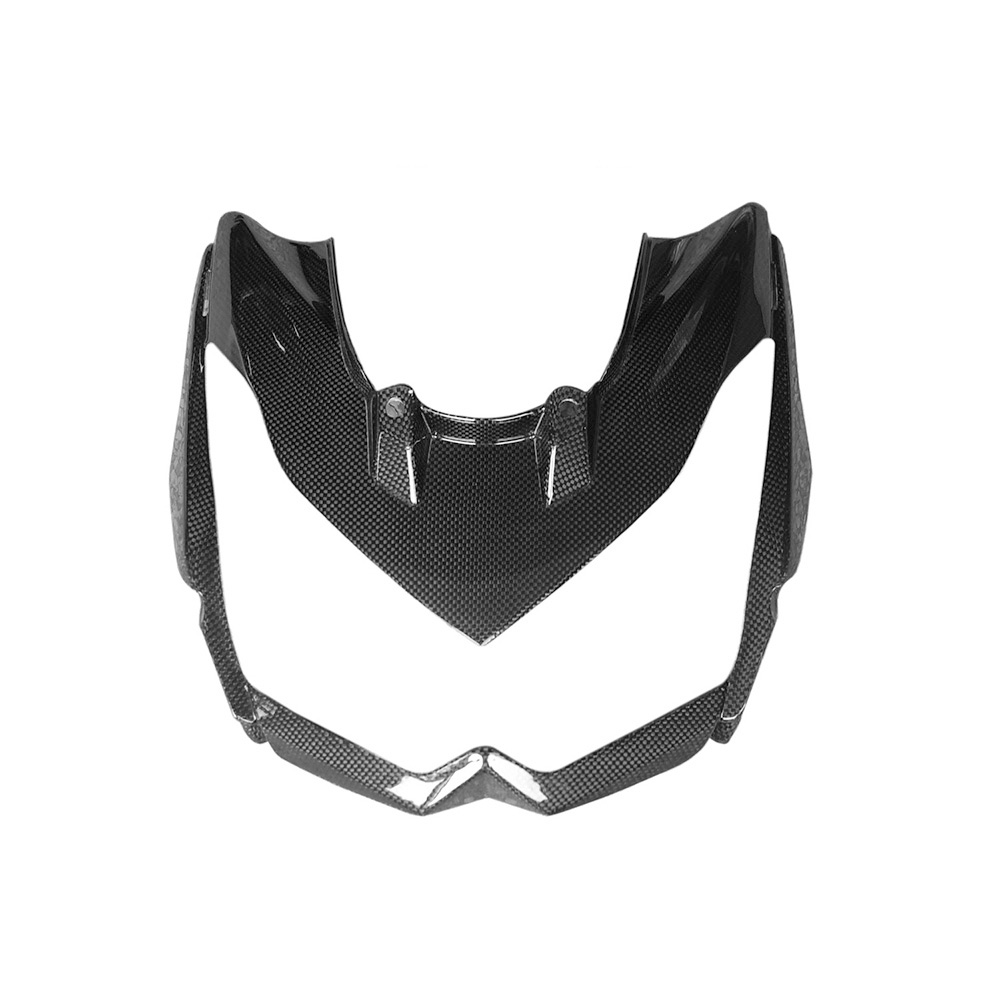
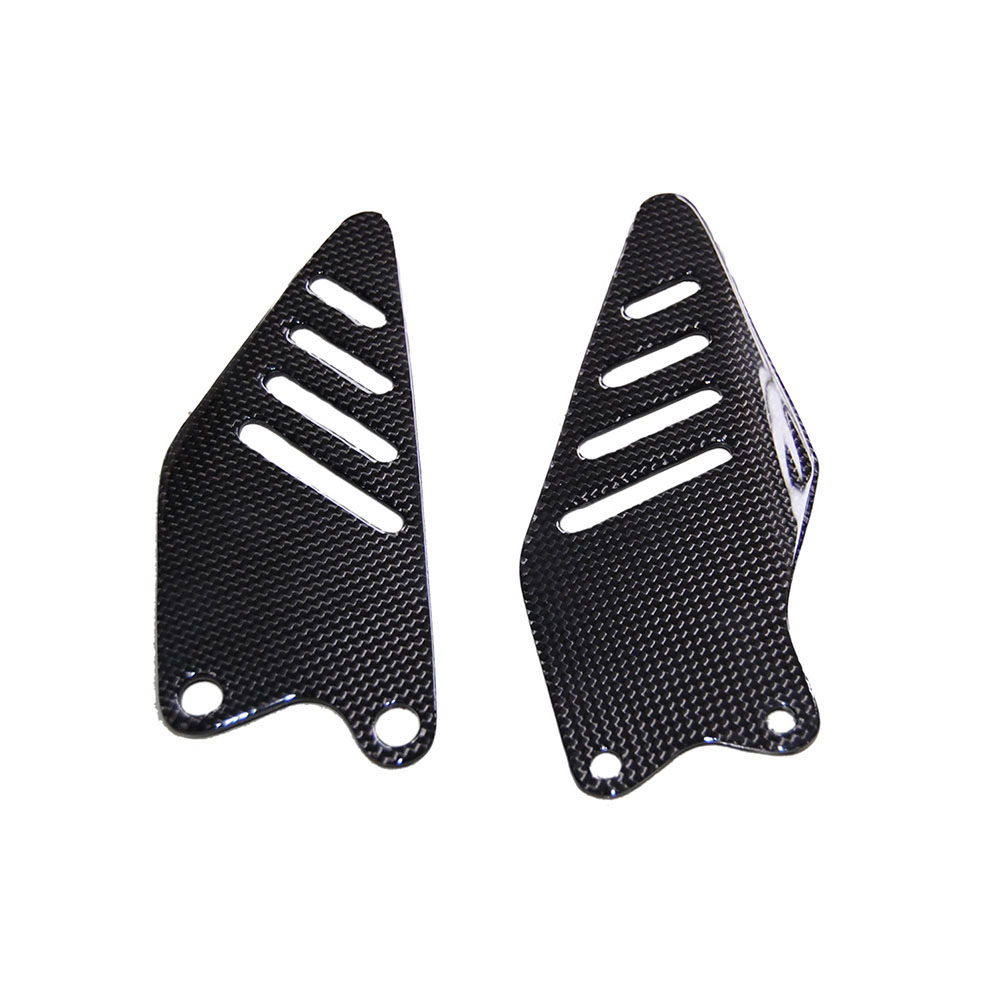
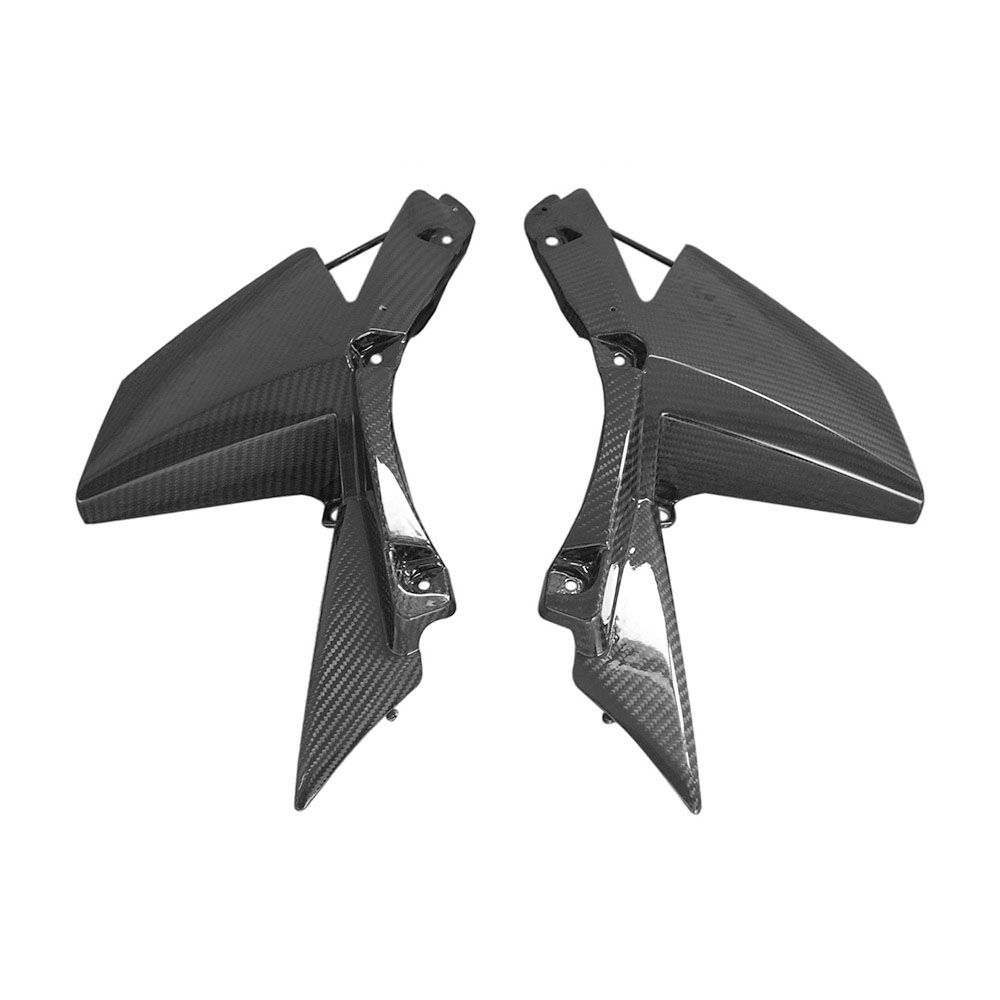
Custom Kawasaki Carbon Fiber Parts for Motorcycle Brands, Distributors and Tuning Projects
As a carbon fiber motorcycle parts manufacturer in China, we manufacture custom Kawasaki carbon fiber parts for aftermarket brands, motorcycle parts distributors, racing teams, tuning shops and private label projects. Our factory has been producing carbon composite components for racing, performance motorcycle and aftermarket applications since 1998.
We support OEM/ODM development from 3D files, original samples, engineering drawings, 3D scan data or clear reference photos. Whether you need replacement-style carbon fiber fairings, lightweight racing bodywork, cosmetic covers or fully custom Kawasaki motorcycle accessories, we can support tooling, prototyping, sample production and batch manufacturing. Material certificates and prepreg batch information can be provided on request for qualified projects.
We manufacture Kawasaki carbon fiber motorcycle parts in dry carbon prepreg, wet carbon vacuum infusion, forged carbon SMC and 3K twill weave, with gloss, matte and satin finish options.
Kawasaki Carbon Fiber Parts We Manufacture
We produce a wide range of exterior, bodywork and protection parts for Kawasaki sport bikes, naked bikes, touring models and custom motorcycle builds.
Common Kawasaki carbon fiber parts include:
- Front fenders
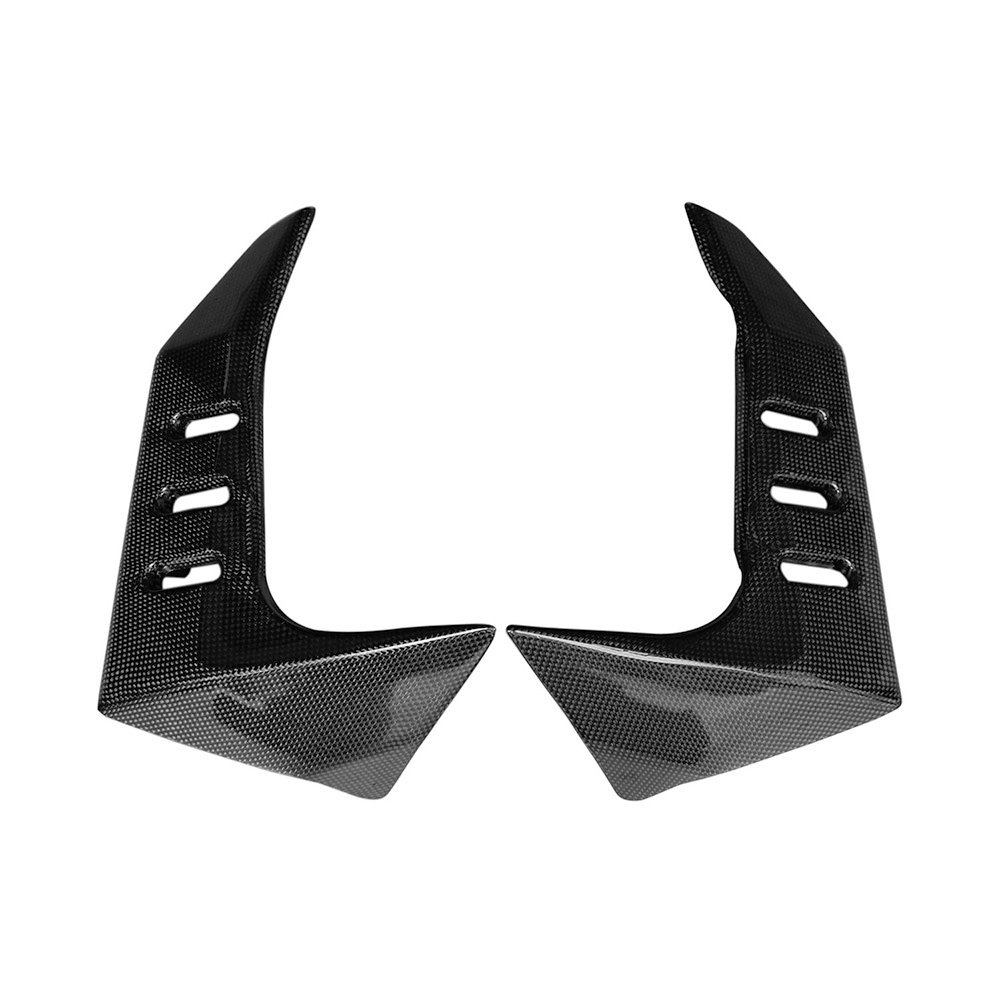
- Rear huggers / swingarm fenders
- Chain guards and chain covers
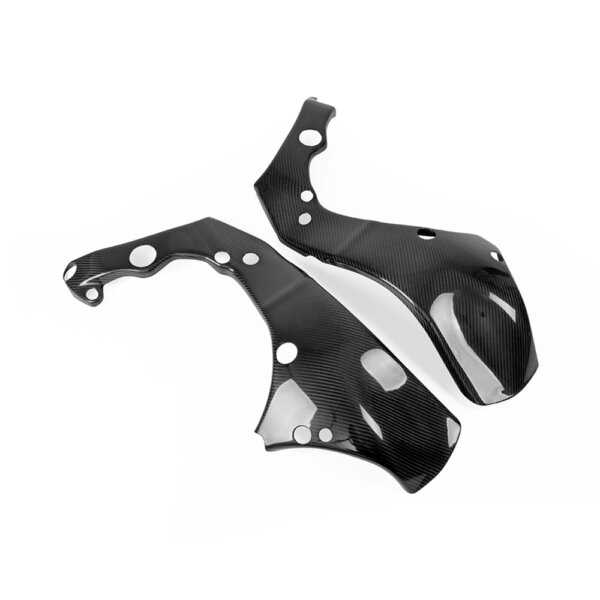
- Frame covers
- Swingarm covers
- Tank covers and tank pads
- Side fairing panels (upper and lower)
- Belly pans
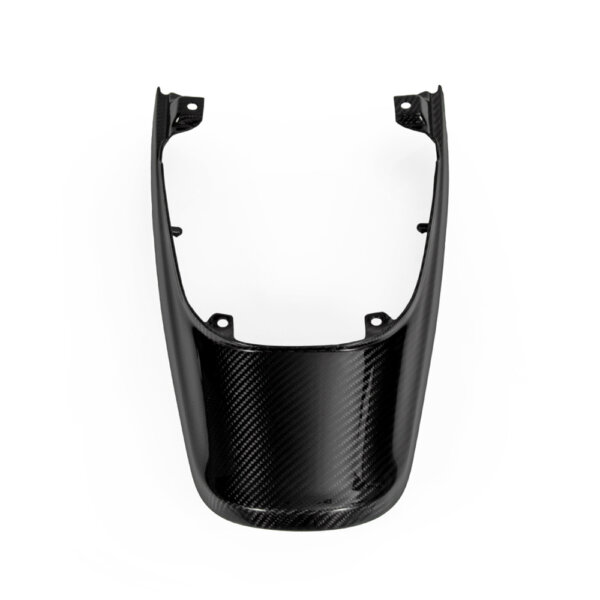
- Seat cowls and tail covers
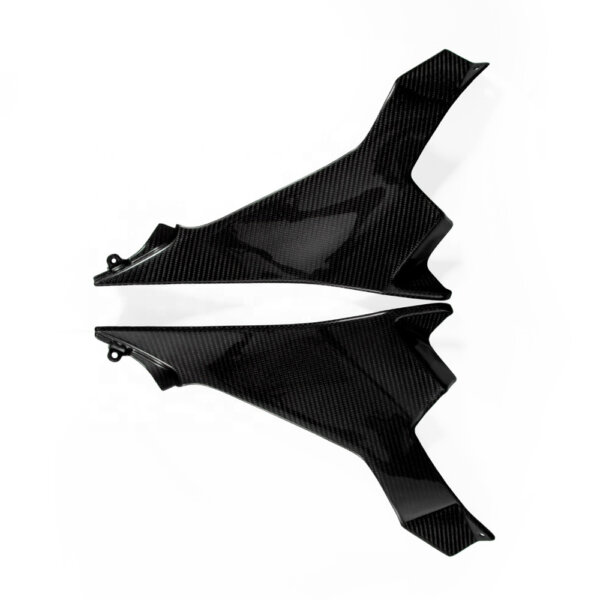
- Air duct covers and intake surrounds
- Heel guards and heel plates
- Radiator side covers
- Engine covers and heat shields
- Inner panels and sub-fairing pieces
- Full custom carbon fiber fairing kits
- OEM/ODM motorcycle body kit parts
For parts with strict fitment requirements, we recommend developing from STEP/STP files, original plastic parts, 3D scan data or physical samples. This controls mounting points, edge trimming, hole position, clearance and final installation accuracy.
Kawasaki Models We Support
We have experience with the following Kawasaki motorcycle platforms. Availability of existing moulds should be confirmed by model year and part type. If your model is not listed, we can evaluate the project based on photos, samples, CAD files or installation requirements.
| Kawasaki Series | Example Models | Common Carbon Fiber Parts |
|---|---|---|
| Kawasaki Ninja | Ninja 400, Ninja 500, Ninja 650, Ninja 1000SX | Fairings, fenders, huggers, seat cowls, tank covers |
| Kawasaki ZX Series | ZX-4R, ZX-6R / 636, ZX-10R, ZX-10RR, ZX-14R | Race fairings, frame covers, swingarm covers, air ducts |
| Kawasaki H2 Series | Ninja H2, Z H2 | Winglets, cowls, fairing panels, covers, custom parts |
| Kawasaki Z Series | Z650, Z800, Z900, Z900RS, Z1000, Z H2 | Rear huggers, belly pans, tank covers, side panels |
| Kawasaki Versys | Versys 650, Versys 1000 | Touring panels, guards, covers and custom accessories |
| Custom / Race Builds | Endurance, track-spec, concept builds | Full OEM/ODM carbon fiber development from scratch |
Dry Carbon, Wet Carbon and Forged Carbon Options
Different Kawasaki motorcycle parts require different production methods depending on budget, structure, appearance and performance requirements. Here is what each method delivers in practice.
Dry Carbon — Prepreg Autoclave
Dry carbon is suitable for high-end Kawasaki carbon fiber parts where lightweight structure, stable thickness and premium surface quality are important. Our autoclave cure process runs at controlled temperature and pressure, producing a thermally stable laminate suitable for exhaust-adjacent and engine-bay fitments.
Fibre volume fraction in autoclave prepreg parts typically reaches 60–65%, compared with 40–55% achievable in wet layup. This is the principal reason dry carbon parts are lighter: more fibre, less resin per unit volume.
Typical applications:
- Racing fairings and full bodywork kits
- Lightweight replacement panels
- High-end private label Kawasaki parts
- Parts requiring dimensional stability at operating temperature
- Premium 3K twill cosmetic carbon fiber parts
Wet Carbon — Vacuum Infusion
Wet carbon or vacuum infusion is selected when the project requires a genuine carbon fiber appearance and structure at a more cost-effective price point. It is appropriate where strict weight targets are secondary to visual quality and budget.
Typical applications:
- Cosmetic covers (frame covers, heel plates, chain guards)
- Medium-volume aftermarket parts
- Motorcycle styling accessories
- Larger panels where budget control matters
Forged Carbon — SMC (Sheet Moulding Compound)
Forged carbon uses short randomly-oriented carbon fibre strands combined with resin, pressed under heat and pressure. The result is a distinctive marbled pattern without directional weave alignment — a modern alternative to traditional 3K twill, adopted in premium automotive and motorcycle accessories.
Typical applications:
- Tank covers, small trim covers, frame covers
- Seat cowls and tail tidy panels
- Custom design parts and private label accessories
- Parts with complex geometry where woven prepreg drapability is limited
Example Weight Comparison: OEM Plastic vs Carbon Fiber Parts
The table below shows typical weight comparisons based on our in-house production records. Actual weight may vary depending on model year, layup schedule, resin system, surface finish and customer requirements. Wet layup parts are approximately 15–20% heavier than the prepreg autoclave figures shown.
| Part | OEM ABS Typical Weight | Carbon Fiber Typical Weight | Typical Saving |
|---|---|---|---|
| ZX-10R (2021+) Tail Section | 1,180 g | 340 g | 840 g — 71% |
| ZX-10R (2021+) Belly Pan | 760 g | 230 g | 530 g — 70% |
| ZX-10R (2021+) Upper Fairing | 2,450 g | 890 g | 1,560 g — 64% |
| ZX-6R (2024+) Rear Hugger | 420 g | 135 g | 285 g — 68% |
| Ninja H2 Tank Cover | 340 g | 95 g | 245 g — 72% |
| Z900 Front Fender | 380 g | 110 g | 270 g — 71% |
| Ninja 400 Belly Pan | 510 g | 155 g | 355 g — 70% |
A full exterior carbon bodywork replacement on a ZX-10R (upper fairing, lowers, belly pan, tail section, both fenders) typically saves approximately 3.2–4.5 kg versus OEM ABS plastic.
3K Twill, Weave Pattern and Finish Options
Most Kawasaki carbon fiber motorcycle parts use 3K twill carbon fiber — the classic 2×2 diagonal interlace pattern recognisable on premium motorsport components. For customers who prefer a different finish or weave style, we also offer the following options.
| Option | Description | Best For |
|---|---|---|
| 3K Twill (standard) | Fine diagonal weave, classic motorsport look | Fairings, fenders, tail sections |
| 1×1 Plain Weave | Tighter checkerboard grid | Naked bike accent parts, Z900, Z650 |
| Forged Carbon | Random short-fibre marbled pattern | Tank covers, small trims, custom parts |
| 12K Twill | Larger, coarser weave pattern | Structural brackets, heat shields |
| Gloss Clear Coat | High shine, deep visual depth | Street / show bikes |
| Matte Clear Coat | Flat/satin, anti-reflective | Track bikes, stealth builds |
| UV-Resistant Clear Coat | Standard on all exterior parts | Road and track use |
| Paint-Ready Surface | Sanded base, no clear coat applied | Custom painted bodywork projects |
All external Kawasaki carbon parts include a UV-resistant clear coat as standard. This finish step is important for any part used outdoors, as unprotected carbon fibre resin is susceptible to UV degradation over time.
OEM/ODM Manufacturing Process for Kawasaki Carbon Fiber Parts
We support both standard-profile replacement parts and fully custom Kawasaki motorcycle projects. Key production steps — including mould development, layup, curing, trimming, finishing and final inspection — are controlled by our team.
Step 1 — Project Evaluation
Send us your Kawasaki model, production quantity, target part list, photos, drawings, 3D files or original samples. For motorcycle parts, fitment accuracy is critical: we review mounting points, hole positions, edge lines, panel gap requirements and clearance from moving components before confirming feasibility.
Step 2 — Mould Development
For custom Kawasaki carbon fiber parts, mould development can be based on:
- STEP / STP 3D files (preferred for dimensional accuracy)
- Original OEM plastic parts (3D scanned in-house)
- 3D scan data supplied by the customer
- CNC-machined master patterns
- Engineering drawings with dimension and tolerance callouts
Moulds are machined in aluminium for shorter production runs or tool steel for larger programmes. For left/right mirrored parts, separate mould structures are generally required. Tooling lead time is typically 3–6 weeks depending on geometry complexity.
Step 3 — Layup, Curing and Fibre Orientation
Depending on the selected process, we use prepreg autoclave, vacuum infusion, compression moulding or other appropriate composite manufacturing methods. Ply orientation is specified by our engineering team according to the part’s strength, thickness, weight and appearance requirements.
Step 4 — Trimming, Drilling and Surface Finishing
After curing, parts are trimmed and cut using suitable tooling, and mounting holes positioned according to the confirmed fitment layout. Surface finishing can include gloss clear coat, matte clear coat, UV sanding or paint-ready surface preparation as specified.
Step 5 — Quality Inspection and Pre-Shipment Confirmation
Before shipment, each part is inspected for appearance, trimming accuracy, mounting area condition, surface finish consistency and general conformance. For new programmes, we can provide photo or video documentation of the first production batch before shipping for customer review.
What Files or Samples Do You Need to Start?
For accurate quotation and production feasibility assessment, provide as much of the following as possible.
For custom Kawasaki carbon fiber parts:
- STEP / STP 3D files — highest priority for complex fairings and fitment-critical parts
- Original OEM motorcycle parts — we can work from physical samples directly
- 3D scan data provided by customer
- Engineering drawings (2D or 3D, with tolerances)
- Clear photographs from at least 4 angles, including fitment photos on the motorcycle
- Part thickness and weight requirements
- Surface finish and weave preference
- Expected order quantity
For simple parts (flat guards, small covers), photos and dimensions may be sufficient for an initial evaluation. For complex fairings, air ducts, tank covers or mounting-sensitive parts, 3D files or physical samples are strongly recommended to reduce tooling revision rounds.
Why Choose Our Factory for Kawasaki Carbon Fiber Parts?
We are a composite manufacturer, not a reseller. Key production steps are managed by our own team with over 25 years of carbon fiber manufacturing experience.
- OEM/ODM manufacturing — we work from your files, your samples or your design brief
- Custom mould development for Kawasaki models and custom motorcycle builds
- Dry carbon, wet carbon, forged carbon and 3K twill production in-house
- Material certificates and prepreg batch information available on request for qualified projects
- Low minimum quantities — sample runs discussed before committing to batch production
- Factory-direct supply for aftermarket brands and global distributors
- Over 25 years of composite manufacturing experience across motorcycle, automotive and industrial applications
- Private label and custom packaging support
- Global shipping via DHL, FedEx and UPS with tracking
You can also view our broader custom carbon fiber manufacturing capabilities for non-motorcycle composite projects.
Kawasaki Carbon Fiber Parts for Aftermarket Brands and Private Label Projects
Many clients are not looking for a single finished part. They need a reliable manufacturing partner to help develop and supply a Kawasaki carbon fiber product line.
We can support:
- New product development from CAD data or reference samples
- Custom Kawasaki motorcycle accessories with your branding
- Private label carbon fiber parts with custom packaging
- Aftermarket product line expansion for existing distributors
- Low-volume trial orders before full programme commitment
- Batch production after sample approval
- Product photography before shipment for your e-commerce listings
For distributors and motorcycle tuning brands, we can also advise on which Kawasaki models and part types are suitable for production based on tooling investment and expected order volume.
Frequently Asked Questions
What is the difference between dry carbon and wet carbon for Kawasaki parts?
Dry carbon (prepreg autoclave) uses resin-pre-impregnated fibre cured under controlled heat and pressure, achieving fibre volume fractions of approximately 60–65% and superior dimensional consistency. Wet carbon (vacuum infusion or hand layup) saturates dry fabric with liquid resin in an open mould, typically achieving 40–55% fibre fraction. In practical terms, a dry carbon ZX-10R tail section typically weighs around 340 g; the equivalent wet layup part is usually 450–520 g. Dry carbon costs more to produce but delivers measurably better weight control and surface quality.
How much weight can carbon fiber save on a Kawasaki ZX-10R?
Based on our production records, a full exterior bodywork replacement (upper fairing, lowers, belly pan, tail section, both fenders) in prepreg autoclave carbon typically saves approximately 3.2–4.5 kg versus OEM ABS plastic. Individual part savings: upper fairing approximately 1.56 kg, tail section approximately 840 g, belly pan approximately 530 g. Actual savings depend on layup specification and model year.
Can you make Kawasaki carbon fiber parts from 3D files?
Yes. We can evaluate and manufacture Kawasaki carbon fiber parts from STEP/STP files, 3D scan data, engineering drawings or original OEM samples. For parts with strict fitment requirements — fairings, huggers, air ducts — 3D files or physical samples are strongly recommended to minimise tooling revisions.
Can you produce a complete Kawasaki carbon fiber fairing kit?
Yes. We can evaluate and produce full fairing kits, race bodywork sets and custom body panel programmes. For complete fairing projects, 3D files or original parts are required for mould development. Typical lead time from approved files to first sample is 5–8 weeks.
Do you make forged carbon Kawasaki parts?
Yes. Forged carbon is available for tank covers, trim covers, frame covers, seat cowls and custom accessories. Feasibility is evaluated based on part geometry, mould structure and surface requirement.
What is the MOQ for custom Kawasaki carbon fiber parts?
MOQ depends on part size, mould cost, process and production complexity. For custom mould programmes, sample orders are typically discussed first, with batch production commencing after sample approval. Please contact us with your part list and target quantity for a specific MOQ and pricing schedule.
What Kawasaki models can you support?
We have experience with Kawasaki platforms including ZX-10R, ZX-6R / 636, Ninja H2, Z900 / Z900RS, Ninja 400 and Z1000, among others. Availability of existing moulds should be confirmed by model year and part type. Other models can be developed as new mould programmes — please contact us with your requirements.
How do I request a quotation?
Send your Kawasaki model, part list, photos, drawings, 3D files or original sample information, along with your required process (dry / wet / forged), surface finish preference and estimated annual quantity. Our engineering team reviews structure, tooling method and production feasibility, then provides a factory quotation typically within 2 business days.
Request a Quote for Kawasaki Carbon Fiber Parts
Looking for a Kawasaki carbon fiber parts manufacturer for your next motorcycle project, private label programme or aftermarket product line?
Send us your model, part list, files or samples. Our engineering team will review the structure, confirm the tooling method and production process, and provide a factory quotation based on your requirements.
Email: [email protected]
WhatsApp / Phone: +86 136 2619 1009
Contact us to discuss your Kawasaki carbon fiber parts project →
Content prepared by the ChinaCarbonFibers Engineering and Technical Content Team. Weight figures are based on in-house production records and are provided as typical reference values only.