Carbon fiber bicycles are widely used in road cycling, mountain biking, gravel riding, e-bikes and premium folding bikes. Their main advantages are low weight, high stiffness-to-weight ratio, vibration damping and the ability to create complex frame shapes that are difficult to achieve with metal.
This guide is published by China Carbon Fibers, a composite material manufacturing factory with experience across bicycle, e-bike, automotive, motorcycle and industrial carbon fiber projects. It explains what makes carbon fiber bicycles different, how they compare with aluminum and steel, which bicycle parts commonly use carbon fiber, and when custom carbon fiber components make sense for bike brands, developers and aftermarket businesses.
What Is a Carbon Fiber Bicycle?
A carbon fiber bicycle is a bicycle where some or all of the structural components — most commonly the frame and fork — are made from carbon fiber reinforced polymer (CFRP). Carbon fiber itself is made from thin strands of carbon atoms arranged in a crystalline structure, woven into fabric and combined with epoxy resin to form a rigid composite material.
In bicycle applications, carbon fiber composites can achieve very low weight while offering high stiffness and tensile strength. This combination makes carbon fiber particularly well suited to bicycle frames, where reducing weight without sacrificing structural integrity directly improves performance.
Not all carbon fiber bicycles are the same. The quality of a carbon fiber bicycle depends on the carbon fiber grade used, the fiber layup design, the manufacturing process, and the quality of the resin system and curing process.
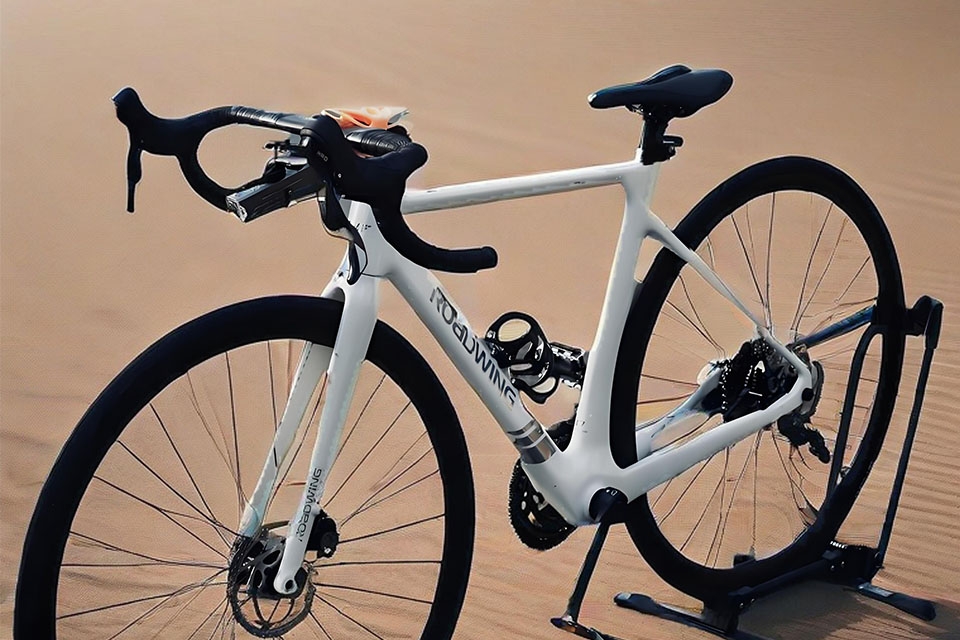
Carbon Fiber vs Aluminum vs Steel: Key Differences
Most bicycle frames are made from one of three materials: carbon fiber, aluminum alloy or steel. Each has different characteristics that affect ride quality, weight, durability and cost.
| Property | Carbon Fiber | Aluminum Alloy | Steel (Chromoly) |
|---|---|---|---|
| Weight | Lightest | Light | Heavier |
| Stiffness | High — tunable by layup design | High — less tunable | Lower — more flex |
| Ride quality | Can be tuned for vibration damping | Stiffer, less vibration absorption | Smooth, compliant ride |
| Strength-to-weight ratio | Excellent | Good | Good |
| Impact resistance | Can crack without visible warning | Dents and deforms visibly | Dents and bends — often repairable |
| Repairability | Possible but requires specialist | Difficult to repair structurally | Relatively easy to weld and repair |
| Cost | Highest | Mid-range | Lower to mid-range |
| Corrosion resistance | Excellent | Good (anodized) | Requires coating |
| Design flexibility | Very high — complex shapes possible | Moderate | Moderate |
Carbon fiber advantages for bicycles: Lighter weight for the same strength, ability to tune stiffness in specific directions through layup design, vibration damping characteristics, and freedom to create complex aerodynamic shapes that are difficult or impossible in metal.
Carbon fiber disadvantages for bicycles: Higher cost, risk of internal damage that is not visible externally, more complex manufacturing, and frames that are more difficult to repair if structurally compromised.
Carbon Fiber Bicycle Pros and Cons
| Pros | Cons |
|---|---|
| Very light weight | Higher cost than aluminum and steel |
| High stiffness-to-weight ratio | Impact damage may not be visible externally |
| Tunable ride feel through layup design | Requires careful torque control on all clamp areas |
| Good vibration damping | More difficult to repair structurally after damage |
| Complex aerodynamic shapes possible | Quality depends heavily on manufacturing and curing control |
| Corrosion resistant | Not all carbon fiber is the same — grade and process matter |
Carbon Fiber Grades Used in Bicycles
Not all carbon fiber is the same. Bicycle manufacturers use different carbon fiber grades depending on the performance target and budget.
T700 carbon fiber is the most commonly used grade in mid-range to performance carbon bicycle frames. It offers high tensile strength and is widely available, making it a practical choice for production bikes.
T800 carbon fiber has a higher tensile modulus than T700, meaning it is stiffer for the same weight. It is used in higher-end performance frames and components where reducing weight or improving stiffness is a priority.
High-modulus and ultra-high-modulus carbon fiber is used in top-tier professional racing components. These grades offer exceptional stiffness but can be more brittle than standard modulus fibers, requiring careful layup design.
UD (unidirectional) carbon fiber is laid with all fibers running in one direction, maximizing strength and stiffness along that axis. It is typically used in structural layers of frames and forks.
3K twill weave is a woven carbon fabric with fibers running in multiple directions. It provides more balanced multi-directional strength and is also commonly used as the visible outer layer for its distinctive woven appearance.
Forged carbon is a short-fiber carbon material pressed into complex shapes under heat and pressure. It is used for smaller components and brackets where production speed and shape complexity matter more than a woven surface appearance.
One important point: higher-grade carbon fiber does not automatically make a better bicycle. The final performance depends on the layup design, resin system, curing process control, wall thickness, reinforcement zones and testing standard. A well-designed T700 frame can be safer and more reliable than a poorly designed frame using higher-modulus fiber.
The same material principles apply across other carbon fiber sectors. Clients interested in how these grades are used in other demanding applications can explore our carbon fiber car parts and carbon fiber motorcycle parts categories, where similar material and process decisions are made under comparable structural and surface finish requirements.
Common Carbon Fiber Bicycle Parts
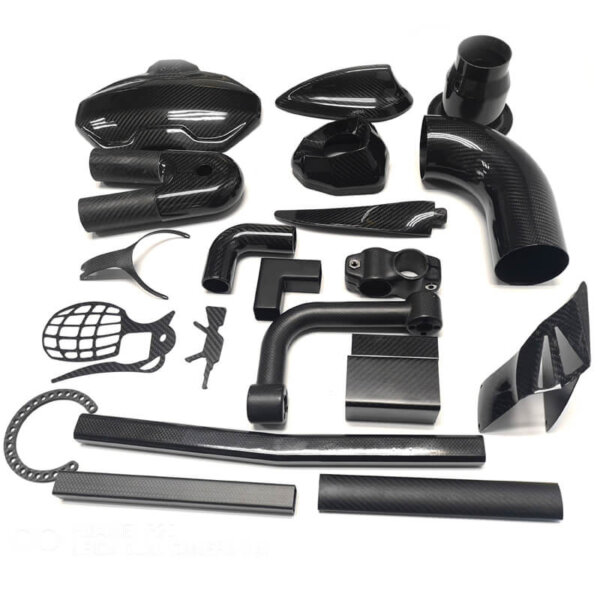
Carbon fiber is used across many parts of a bicycle, not just the frame. The following components are commonly manufactured in carbon fiber:
Frame: The main structural component. Carbon fiber frames can be designed with complex tube profiles and variable wall thickness that are not possible in metal, allowing engineers to tune stiffness and weight distribution across different zones of the frame.
Fork: The front fork is one of the most common carbon fiber bicycle parts. A full carbon fork reduces unsprung weight, improves steering responsiveness and can be designed to absorb road vibration through its layup.
Handlebar: Carbon fiber handlebars are lighter than aluminum and can be designed to reduce vibration transmission to the rider’s hands. Road integrated bars and drop bars are commonly available in carbon fiber.
Seatpost: Carbon fiber seatposts reduce weight and can provide a degree of vertical compliance, improving comfort on rough road surfaces.
Wheels and rims: Carbon fiber rims are significantly lighter than aluminum equivalents and allow for deeper aerodynamic profiles. Carbon fiber wheelsets are a common upgrade on road and time trial bikes.
Stem: Carbon fiber stems reduce weight at the front end of the bike.
Crank arms: Carbon fiber cranks offer weight savings on performance road and mountain bikes.
Saddle shell: Many performance saddles use a carbon fiber shell as the base structure under the padding.
Fender / mudguard: Carbon fiber fenders are popular in the aftermarket for MTB and road bikes, replacing plastic OEM fenders with lighter alternatives.
Bottle cage: One of the simplest carbon fiber bicycle accessories, offering weight reduction at relatively low cost.
For safety-critical parts such as frames, forks, handlebars, rims, stems and crank arms, material choice alone is not enough. These parts should be designed around real load cases, rider weight, fatigue requirements, clamp areas, insert strength and applicable testing standards such as ISO 4210 for bicycles or EN 15194 for e-bikes.
Carbon Fiber Road Bikes
Road bikes were among the earliest bicycle categories to widely adopt carbon fiber frames and components. The demands of road racing — maximizing speed while minimizing weight — made carbon fiber an obvious choice once manufacturing costs became accessible.
Modern carbon fiber road bikes use sophisticated layup designs to create frames that are stiff at the bottom bracket for efficient power transfer while remaining more compliant at the seat tube and fork for rider comfort. This level of tuning is not achievable in aluminum or steel.
Aerodynamic tube profiles are another key benefit. Carbon fiber allows frame tubes to be shaped into complex aero profiles that would be extremely difficult to produce in metal at the same weight.
Carbon Fiber Mountain Bikes (MTB)
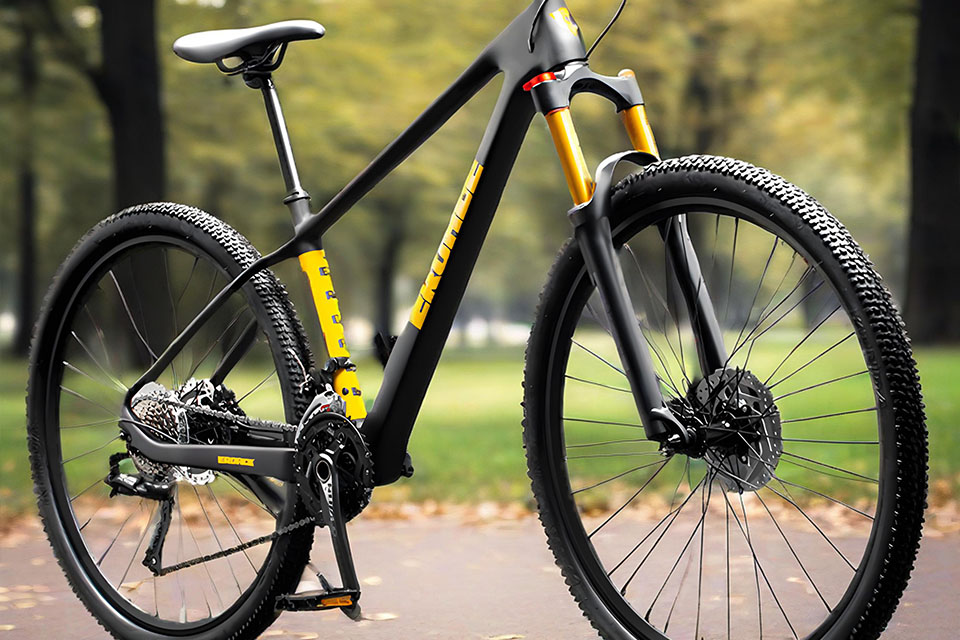
Mountain bikes place different demands on carbon fiber than road bikes. Where road frames prioritize minimum weight and vertical compliance, MTB frames must withstand repeated impacts, torsional loads and the stress of suspension linkages.
Carbon fiber MTB frames — particularly hardtail frames and full suspension frames — are engineered with reinforced zones around the bottom bracket, head tube and suspension pivots where loads are highest. The ability to vary fiber orientation and ply thickness in different areas is a key advantage of carbon fiber for MTB applications.
For aftermarket MTB projects, carbon fiber fenders, guards, handlebar components and protective covers are often more practical starting points than developing a full custom carbon frame. These parts have simpler geometry, lower tooling cost and shorter development cycles.
Carbon Fiber Gravel Bikes
Gravel bikes combine road geometry with the ability to handle unpaved surfaces. Carbon fiber gravel frames are designed to balance low weight with enough compliance to reduce fatigue on long mixed-surface rides.
Many carbon fiber gravel frames use shaped seat stays and seatpost designs that allow some vertical flex without sacrificing lateral stiffness, using the directional tunability of carbon fiber layup to achieve performance targets that would require compromises in aluminum.
Carbon Fiber E-Bikes
E-bikes introduce additional complexity for carbon fiber components. The added weight of the motor, battery and controller systems makes weight savings elsewhere more valuable — and carbon fiber components can offset some of the system weight penalty.
However, e-bike frames must also handle the higher torque loads from electric drive systems, which changes the structural requirements compared with conventional bicycle frames.
For OEM and ODM e-bike projects, carbon fiber is often used not only for frames, but also for battery covers, motor covers, frame panels, guards and lightweight housings. These parts can reduce overall system weight while improving the visual quality and perceived value of the finished product.
Carbon Fiber Folding Bikes
Folding bikes present unique engineering challenges for carbon fiber. The hinge mechanisms and fold joints introduce stress concentrations that require careful design. Some premium folding bikes use carbon fiber for the main tubes and panels while retaining metal at the hinge points.
Carbon fiber is used in folding bike frames primarily to offset the weight penalty of the folding mechanism hardware, keeping the overall bike weight low enough for practical portability.
How Carbon Fiber Bicycle Parts Are Manufactured
Understanding how carbon fiber bicycle parts are made helps buyers evaluate quality and ask the right questions of suppliers.
Prepreg molding is the most common process for high-quality structural bicycle parts. Pre-impregnated carbon fiber sheets are laid into precision tooling and cured under controlled temperature and pressure. This gives consistent fiber-to-resin ratios and high structural performance.
Bladder molding is used for hollow parts such as handlebars and frame tubes. An inflatable bladder inside the layup applies internal pressure during curing, consolidating the carbon against the mold walls.
Compression molding is used for smaller parts such as fenders, guards and brackets, pressing carbon fiber mat or short-fiber material in matched metal tooling.
Resin infusion and wet layup are lower-cost processes used for larger covers and housings where weight is less critical.
The quality of a finished carbon fiber bicycle part depends on the material grade, layup design, mold precision, curing process control and post-cure inspection. Parts manufactured with uncontrolled processes or unknown-grade fiber can look identical to high-quality parts externally while having very different structural performance. To learn more about our manufacturing background and facility, visit our About page.
Open-Mold vs Custom Carbon Fiber Bicycle Parts
Open-mold carbon bicycle parts use existing tooling shared by multiple brands. This is faster and lower-cost, but the geometry is not unique to your brand — other companies may sell an identical frame or component under a different name.
Custom carbon fiber bicycle parts require new tooling developed from your design, or reverse engineering from a physical sample. This costs more and takes longer, but allows unique geometry, private tooling, special surface finish and stronger brand differentiation.
For many new brands, the practical route is to start with custom accessories or covers — fenders, guards, e-bike battery covers, handlebars — before investing in a full custom carbon frame. This reduces upfront tooling risk while still giving the brand unique components.
Carbon Fiber Bicycle Maintenance and Care
Carbon fiber bicycles require some specific care compared with metal frames:
Torque limits matter. Carbon fiber components, particularly handlebars, stems and seatposts, have torque specifications for clamping bolts. Exceeding these can cause internal damage that is not immediately visible. Always use a torque wrench and follow the manufacturer’s specifications.
Inspect after impacts. Unlike metal, carbon fiber can sustain internal damage from impacts without showing visible external cracking. After any significant impact, inspect the affected area carefully and, if in doubt, have the part checked by a specialist before riding.
Use carbon-specific assembly paste. When fitting carbon fiber components into clamps, use carbon assembly paste. This allows clamping at lower torque values without slipping, reducing the risk of over-torquing.
Protect against UV over time. Extended UV exposure can degrade the epoxy resin in carbon fiber composites. Most frames have UV-protective clear coats, but additional protection is advisable on high-wear areas.
Avoid heat. High temperatures can soften the epoxy resin matrix. Leaving a carbon fiber bicycle in a hot car or exposing it to direct heat sources can compromise structural integrity.
For B2B buyers and product developers, these maintenance considerations also affect component design. Clamp zones, UV-resistant clear coats, reinforced mounting areas and clear installation torque specifications should be addressed during the component development stage, not left to the end user to manage.
When Custom Carbon Fiber Components Make Sense
Not every bicycle project needs custom carbon fiber components. Standard open-mold frames and components offer a lower-cost, faster route to market for many brands.
Custom carbon fiber bicycle components make sense when:
- You need a part that does not exist in any standard open-mold catalog
- Your design has unique geometry, proprietary features or structural requirements that differ from standard parts
- You need to replace an existing plastic or aluminum part with a carbon fiber equivalent for weight reduction or aesthetic improvement
- You are developing an e-bike product with specific housing, cover or structural requirements
- You want full design ownership and exclusive tooling that no other brand can use
For brands launching a new bicycle line with limited development budget, beginning with custom carbon fiber accessories rather than immediately investing in a full custom frame mold is often a more practical approach. Fenders, handlebars, guards, bottle cages and e-bike covers all have lower tooling costs and shorter development cycles than a full frame. You can see the broader range of custom carbon fiber projects we support across industries on our website.
Is a Carbon Fiber Bicycle Worth It?
A carbon fiber bicycle is worth it when low weight, stiffness, vibration damping and aerodynamic shape matter to the rider or product design. It makes the most sense for road racing, gravel riding, performance MTB, premium e-bikes and high-end folding bikes.
For general commuting, rental fleets or low-cost utility bicycles, aluminum or steel may offer better value. They are cheaper, easier to visually inspect after impact and more practical for heavy daily use where precise torque control and careful maintenance are less likely.
For B2B projects, the question is not simply whether carbon fiber is “worth it” — it is which components justify the cost. In many projects, custom carbon fiber fenders, guards, battery covers, handlebar components or frame sections offer a better starting point than committing immediately to a full custom carbon frame, which requires higher tooling investment and structural testing before it can go to market.
FAQ About Carbon Fiber Bicycles
Are carbon fiber bicycles better than aluminum bikes?
Carbon fiber bicycles are lighter and more tunable than aluminum bikes, but they are more expensive and require more careful inspection after impact. Aluminum is often better suited to lower-cost utility bikes and applications where easy repairability matters. Carbon fiber is preferred for performance and premium applications where weight and ride quality are the priority.
How long does a carbon fiber bicycle last?
A well-made carbon fiber bicycle can last for many years if it is not damaged by impact, over-torqued clamps or excessive heat. Lifespan depends on material quality, resin system, layup design, riding conditions and maintenance. Parts that have been crashed or subjected to abnormal loads should be inspected by a specialist before continued use.
Can carbon fiber bicycle frames crack?
Yes. Carbon fiber frames can crack from impact, overloading, improper clamping or manufacturing defects. Some damage may be internal and not immediately visible externally. Inspection after any significant crash is important, as riding on a structurally compromised carbon frame carries risk.
Is T800 carbon fiber better than T700 for bicycles?
T800 can offer higher stiffness-to-weight performance than T700, but it is not automatically the better choice. A well-designed T700 layup can outperform a poorly designed T800 frame. The fiber grade is one factor among many — layup design, resin system, curing control and testing standard all affect the final performance and safety of the part.
Which bicycle parts are best to start with for custom carbon fiber development?
Common and practical starting points include fenders, guards, e-bike battery covers, handlebars, bottle cages, saddle shells and frame cover sections. These parts have simpler geometry, lower tooling cost and shorter development cycles than a full custom frame. Full custom frames require higher tooling investment and more comprehensive structural testing before they can be brought to market.
Summary
Carbon fiber bicycles offer genuine advantages in weight, stiffness tunability and aerodynamic design freedom compared with aluminum and steel. These advantages are most significant for performance road bikes, competition MTB, gravel bikes and premium e-bike builds.
For B2B buyers — bike brands, product developers, e-bike integrators and aftermarket businesses — the key question is not just whether to use carbon fiber, but which components to develop in carbon fiber, and whether to use standard open-mold options or invest in custom tooling for proprietary components.
Need custom carbon fiber bicycle parts for an OEM or ODM project? Visit our custom carbon fiber bike parts manufacturer page to learn about materials, mold making, manufacturing processes, testing support and quotation requirements.
Published by China Carbon Fibers — a carbon fiber composite manufacturing factory serving B2B clients in the bicycle, e-bike, automotive, motorcycle and sports equipment sectors.