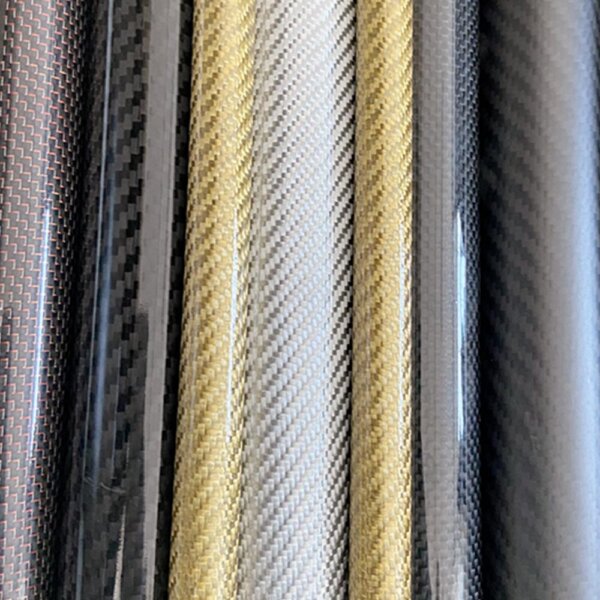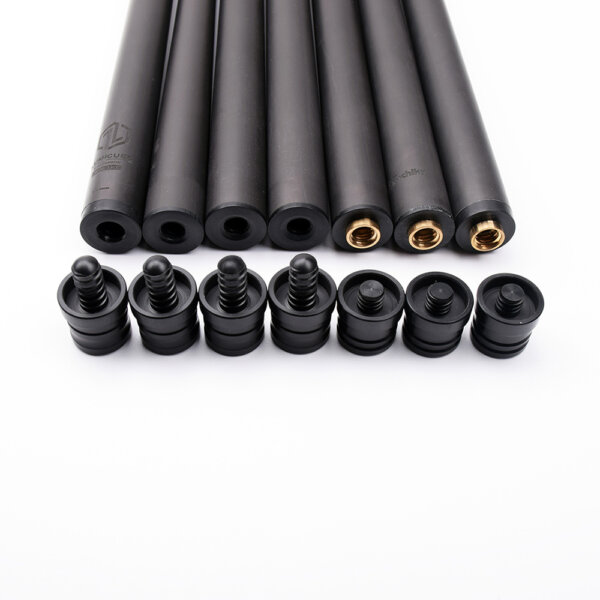
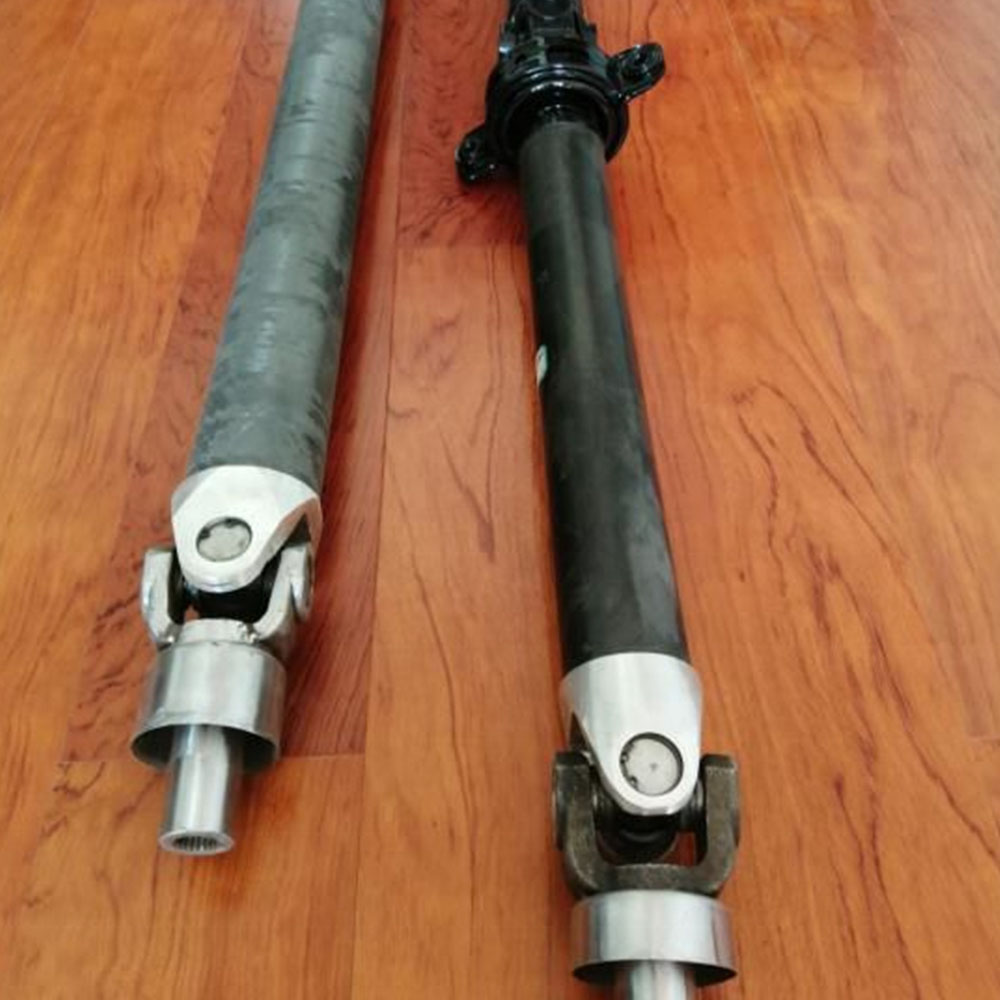
Written from the factory floor — practical notes from decades of combined composite manufacturing experience producing custom CFRP tubes for aerospace, medical, UAV, marine, and industrial customers.
Introduction: Why This Guide Is Different
Most “carbon fiber tube China” articles are written by content marketers who have never stood next to a mandrel winder or watched a tube come out of an autoclave. This one isn’t.
We manufacture carbon fiber tubes every day — pultruded, roll-wrapped, filament-wound, and prepreg/autoclave — and we’ve seen almost every mistake a buyer can make when sourcing from China: wrong tow count for the load case, resin-starved layups that fail in the field, MOQ traps, and “certified” suppliers who are actually trading companies with no factory at all.
This guide covers what the marketplace listings won’t tell you:
- What a carbon fiber tube (CFRP tube) actually is, structurally
- How tubes are really made, process by process, with the engineering trade-offs
- How to read tow count, weave, layup angle, and fiber grade specs like an engineer
- What drives price and MOQ, beyond a simple table
- How to tell a real factory from a trading company
- The defects that actually cause tube failures — and how to catch them before shipment
- A practical RFQ checklist and buyer mistake list drawn from real orders
If your application needs something beyond a standard round tube, this guide pairs well with our broader custom carbon fiber solutions, which cover shapes, hybrids, and application-specific configurations.
If you only need a quick supplier list, you can skip to Section 6, “How to Choose a Manufacturer in China.” If you’re an engineer or procurement lead who wants to actually understand what you’re buying, start from the top.
About Our Carbon Fiber Tube Manufacturing Experience
We are a carbon composite manufacturer based in Suzhou, China, with years of hands-on experience manufacturing custom CFRP tubes and components for global OEM and industrial customers. Our production capability spans composite layup, molding, CNC machining, surface finishing, and export packaging for overseas customers — not just design and quotation.
- Processes in-house: pultrusion, roll wrapping, filament winding, oven and autoclave curing
- Fiber grades used: T300, T700, T800
- Equipment: autoclave, CNC machining centers, precision mandrels, in-house oven curing
- Industries served: UAV/drone, medical devices, automotive, marine, robotics, sporting goods, industrial equipment
- Quality assurance: dimensional inspection, batch documentation, and material test reports available according to project requirements
For a closer look at our facility and equipment, see our factory and equipment overview, or learn more about our company and manufacturing background.
1. What Is a Carbon Fiber Tube (CFRP Tube)?
A carbon fiber tube is a hollow structural profile made from carbon fiber reinforced polymer (CFRP) — continuous carbon filaments held in a cured resin matrix (usually epoxy, sometimes vinyl ester or phenolic for fire-rated applications).
Structurally, a carbon fiber tube is not “one material.” It’s a composite system with three variables that determine its performance:
- Fiber — carries the load (tension, compression, bending)
- Resin matrix — transfers load between fibers and resists shear/compression buckling
- Fiber architecture — the angle, stacking order, and count of fiber layers, which determines whether the tube is stiff in bending, torsion, or both
This is why two tubes with the same outer diameter and wall thickness can have wildly different strength, stiffness, and failure modes. A tube spec sheet that only lists OD/ID/length is incomplete — and if a supplier can’t tell you the layup, that’s a warning sign, not a shortcut.
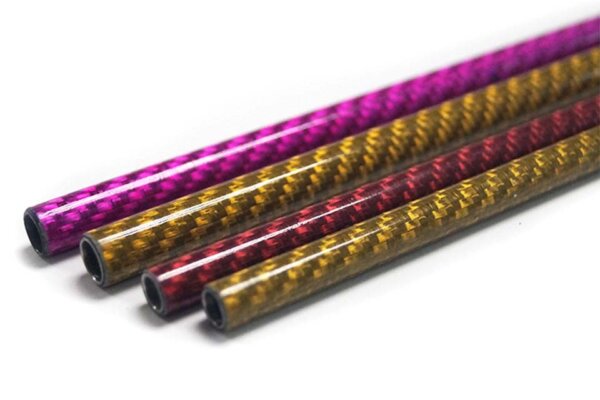
Carbon Fiber Tube vs. Aluminum vs. Steel vs. Titanium
| Property | Carbon Fiber Tube (CFRP) | Aluminum 6061 | Steel (mild) | Titanium Gr.5 |
|---|---|---|---|---|
| Density (g/cm³) | 1.5–1.6 | 2.7 | 7.85 | 4.43 |
| Specific tensile strength | Very high | Medium | Medium | High |
| Stiffness tunability | Yes (layup-dependent) | No (isotropic) | No (isotropic) | No (isotropic) |
| Corrosion resistance | Excellent | Good | Poor (needs coating) | Excellent |
| Fatigue resistance | Excellent | Fair | Fair–Good | Good |
| Thermal expansion | Near-zero (axial) | Moderate | Moderate | Low |
| Machinability | Requires special tooling | Easy | Easy | Difficult |
| Typical cost per part | Higher | Lower | Lowest | Highest |
The practical takeaway for buyers: carbon fiber tubes win on weight-to-stiffness ratio and fatigue life, not on raw cost per kilogram. If your application doesn’t care about weight or vibration, you may not need carbon fiber at all — an honest supplier will tell you this instead of just quoting.
2. How Carbon Fiber Tubes Are Actually Made
There are four manufacturing processes used for carbon fiber tubes in China, and they are not interchangeable — each produces a tube with different mechanical behavior. Choosing the wrong process for your application is the single most common engineering mistake we see from first-time buyers.
As a custom CFRP tube manufacturer, we’re often asked which process is “best” — but the honest answer is that the right lightweight composite tube solution depends entirely on the load case, not a single default process. You can see the full range of processes we run in-house on our carbon fiber tube manufacturer page.
2.1 Pultrusion
Continuous carbon fiber roving is pulled through a resin bath, then through a heated steel die that shapes and cures the tube in one continuous pass.
- Fiber orientation: almost entirely 0° (axial, unidirectional)
- Strength profile: excellent axial tensile/compressive strength, poor torsional and hoop strength
- Best for: long straight tubes, poles, structural members with axial loading — antenna masts, tent poles, straight structural spars
- Not suitable for: parts under torsion or complex bending, since there’s little to no fiber running at ±45°
2.2 Roll Wrapping
Pre-impregnated (prepreg) carbon fiber sheet is cut to a specific angle pattern, then rolled around a steel or aluminum mandrel by hand or machine, compacted, and cured in an oven under heat-shrink tape tension.
- Fiber orientation: fully customizable — layers can be stacked at 0°, ±45°, 90°, or any combination
- Strength profile: tunable — this is the process used when a tube needs both bending stiffness and torsional strength
- Best for: drone arms, camera rigs, bike/e-bike frames, robotics arms, custom OEM tubes with mixed loading
- Trade-off: more labor-intensive, higher cost per piece than pultrusion, lower dimensional consistency unless the factory uses precision mandrels and controlled cure cycles
2.3 Filament Winding
Continuous resin-impregnated fiber tow is wound around a rotating mandrel at a controlled angle and tension, then cured.
- Fiber orientation: helical, angle-controlled (commonly 15°–75° from axis)
- Strength profile: excellent hoop strength and torsional stiffness — ideal for pressure-bearing or torque-transmitting tubes
- Best for: driveshafts, pressure vessels, marine prop shafts, torque tubes
- Trade-off: requires specialized winding equipment; not economical for very short production runs
2.4 Prepreg / Autoclave Molding
Similar to roll wrapping but cured in an autoclave under simultaneous heat and pressure, which minimizes voids and maximizes fiber volume fraction.
- Cure conditions: depending on the resin system and application requirements, autoclave cure typically runs at elevated pressure (several bar) and temperatures in the range of roughly 120–180°C — the exact cycle is set by the resin manufacturer’s datasheet, not a fixed universal number
- Strength profile: the highest achievable strength-to-weight ratio and the lowest void content of any process
- Best for: aerospace components, medical devices (surgical instrument shafts, prosthetics), high-end sporting goods
- Trade-off: highest cost, longest lead time, requires autoclave capacity — many “factories” on marketplaces subcontract this step without telling you
Which Process Should You Choose?
| If your tube needs to… | Choose |
|---|---|
| Resist bending/axial load, stay straight, low cost | Pultrusion |
| Resist bending and torsion, custom shape | Roll wrapping |
| Transmit torque or resist internal/external pressure | Filament winding |
| Meet aerospace/medical certification, max strength-to-weight | Prepreg/autoclave |
Quick Reference: Carbon Fiber Tube Selection Guide
| Application | Recommended Process | Fiber Grade | Typical Layup |
|---|---|---|---|
| Drone / UAV arm | Roll wrapped | T700 | 0° / ±45° / 90° |
| Medical shaft or rod | Pultrusion or roll wrap | T700 | UD (0°) |
| Racing / drive shaft | Filament winding | T800 | ±45° |
| Aerospace structural tube | Prepreg / autoclave | T800 | Multi-axis, engineered layup |
| Fishing rod / ski pole (tapered) | Roll wrapped | T700 (cosmetic 3K outer layer) | Tapered UD + hoop |
| Marine prop shaft | Filament winding | T700 | ±45° with hoop layers |
| Camera rig / tripod leg | Roll wrapped | T700 | 0° / 90° |
This table is a starting point, not a substitute for engineering review — always confirm layup against your actual load case, especially for anything combining bending and torsion.
3. Reading a Carbon Fiber Tube Spec Sheet Like an Engineer
3.1 Tow Count (3K / 6K / 12K / 24K)
Tow count is the number of individual carbon filaments bundled into one strand (1K = 1,000 filaments).
- 3K — finest visible weave, best cosmetic finish, used where appearance matters (visible parts, sporting goods) — slightly lower strength-per-weight than heavier tows due to more resin-rich zones at crossover points
- 6K–12K — a common structural default; good balance of strength, weight, and cost
- 24K+ — used for high-volume structural pultrusion where cosmetic weave pattern doesn’t matter
If your part is hidden inside an assembly, don’t pay a premium for 3K cosmetic weave — spec 12K and save cost without losing structural performance.
3.2 Fiber Grade: T300 vs T700 vs T800 vs T1000
These are Toray-originated (and Chinese-equivalent) fiber grade designations that indicate tensile strength and modulus:
| Grade | Tensile Strength (approx.) | Typical Use |
|---|---|---|
| T300 | ~3,530 MPa | General industrial, cost-sensitive parts |
| T700 | ~4,900 MPa | Most common structural/sporting goods grade |
| T800 | ~5,880 MPa | High-performance, weight-critical parts |
| T1000 | ~6,370 MPa | Aerospace-grade, premium applications |
Buyer tip: many suppliers will quote “T700” without providing a material test report (MTR) or certificate of conformance. Chinese-domestic equivalents (e.g., from Toray-licensed or domestic fiber producers) can meet the same spec, but you should always request the MTR with batch traceability — not just a spec sheet claim.
3.3 Layup and Fiber Angle
The layup — the stacking sequence and angle of each fiber layer — determines how the tube behaves under load:
- 0° (axial/UD) layers resist bending and axial tension/compression
- ±45° layers resist torsion and shear
- 90° (hoop) layers resist crushing/ovalization and internal pressure
A tube spec’d only as “UD carbon fiber, high strength” with no layup schedule is an incomplete spec. For any torque-bearing or multi-axis-loaded part, ask your supplier for the layup schedule (e.g., [0°/±45°/90°/±45°/0°]) — a competent factory will have this documented for every custom tube they produce.
A note on carbon fiber tube OD ID and wall thickness tolerance: these three dimensions are the most commonly mis-specified values in RFQs we receive. Wall thickness is a derived value (OD minus ID, divided by two) — if you specify all three independently without checking they’re mathematically consistent, you’ll get a quote based on whichever the supplier assumes is correct. Always confirm which dimension is critical-to-function (usually ID, for a shaft that needs to fit inside it, or OD, for a part that needs to fit inside a housing) and give a tighter tolerance only on that one — over-tolerancing every dimension unnecessarily increases cost.
3.4 Resin Systems
- Epoxy — the default for most structural tubes; good strength, moderate temperature resistance (up to ~120–150°C for standard cure)
- High-Tg epoxy — for parts exposed to higher operating temperatures (engine bays, industrial ovens)
- Vinyl ester — better chemical/UV resistance, used in marine and outdoor applications
- Phenolic — used where fire, smoke, and toxicity (FST) ratings matter, e.g., transportation and rail
If your application needs a resin system, fiber blend, or hybrid material outside these defaults, our custom material solutions page covers the options we can engineer around.
4. Common Tube Shapes and Configurations
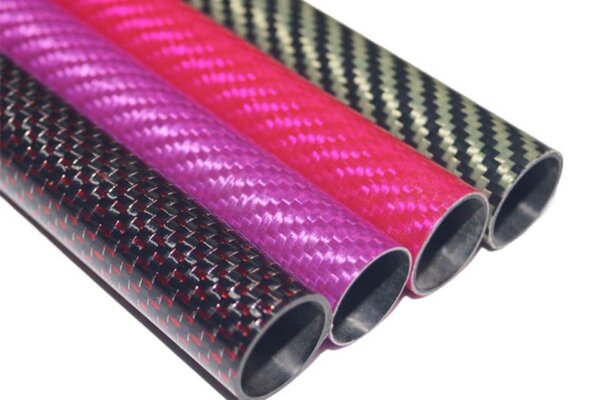
- Round tube — the default; simplest to manufacture, most cost-effective
- Square / rectangular tube — for flat mounting surfaces or bolted joints
- Oval / airfoil tube — reduces drag, used in aerospace and high-speed sporting applications
- Tapered tube — variable OD along the length (fishing rods, poles, ski poles) — requires roll wrapping or prepreg, not compatible with pultrusion
- Telescopic tube sets — matched OD/ID tolerances across multiple tube segments for sliding/nesting fit (camera poles, tripod legs, telescoping masts)
- Hybrid tubes — carbon fiber combined with Kevlar (impact resistance) or fiberglass (cost reduction, electrical insulation)
For shaft-style applications specifically — where the tube also functions as a load-bearing or rotating shaft rather than just a structural tube — see our dedicated custom carbon fiber shaft tube page.
5. Price and MOQ: What Actually Drives Cost
Marketplace listings show a single number, but the real price of a custom carbon fiber tube depends on five variables. Understanding them lets you negotiate intelligently instead of just comparing quotes blindly.
| Cost Driver | Low-Cost End | High-Cost End |
|---|---|---|
| Process | Pultrusion | Prepreg/autoclave |
| Fiber grade | T300 | T800/T1000 |
| Tolerance | Standard (±0.2–0.3mm) | Precision (±0.05mm) |
| Layup complexity | Simple UD | Multi-angle custom layup |
| Quantity | High volume | Sample/small batch |
| Finishing | As-cured matte | Painted, clear-coated, printed |
Typical order structure we see from OEM buyers:
| Order Stage | Typical Quantity | Purpose |
|---|---|---|
| Sample / proof of concept | 1–10 pcs | Validate fit, finish, mechanical performance |
| Pilot batch | 50–200 pcs | Field testing, first production run |
| Production order | 500+ pcs | Ongoing supply, tiered pricing usually applies |
If a supplier refuses to do a sample order before a production MOQ, that’s a red flag — legitimate factories are used to sample requests and will typically only charge tooling/mandrel cost, refundable or creditable against a future production order.
Need a Custom Carbon Fiber Tube Quote?
Send us your drawing or these basics and our engineers will recommend the right process, fiber grade, and layup for your load case — not just a price:
- OD / ID / length
- Application and primary load direction (bending, torsion, axial, pressure)
- Required quantity (sample and production)
- Any certification requirements
Contact our engineering team to get started.
6. How to Choose a Manufacturer in China (Not a Trading Company)
This is the step most buyers get wrong, and it’s the single biggest source of quality problems. Not every “supplier” on Alibaba owns a factory.
How to verify you’re talking to an actual manufacturer:
- Ask for a live factory video call, not just photos — a real factory will show you the winding/rolling floor, autoclave (if applicable), and QC area without hesitation.
- Request the business license and cross-check the registered scope — Chinese business licenses list the legal scope of operation; composite manufacturing should be explicitly listed.
- Ask who makes the mandrel/tooling — trading companies typically can’t answer this in technical detail; factories will describe their tooling process specifically.
- Request a Material Test Report (MTR) with batch number — not a generic spec sheet, an actual test report tied to the material lot used for your order.
- Check certifications relevant to your industry:
- ISO 9001 (general quality management)
- AS9100 (if aerospace)
- ISO 13485 (if medical device components)
- RoHS / REACH (if selling into EU)
- Ask about subcontracting — many trading companies quote autoclave/prepreg capability they don’t own in-house, then subcontract without informing the buyer. Ask directly: “Is this process done in your own facility?”
Red Flags
- Prices dramatically below the market range for the stated process/grade
- No willingness to provide a layup schedule or MTR
- Refusal to do a paid sample before a large MOQ commitment
- Generic stock photos instead of factory-specific images/videos
- Certifications listed on the website but not provided as documents on request
7. Custom OEM Manufacturing Process, Step by Step
For buyers sourcing a fully custom tube (not an off-the-shelf size), here’s what a proper development cycle looks like:
- Drawing / CAD review — supplier reviews your 2D/3D drawing, confirms OD/ID/length, tolerances, and load requirements
- Process and material selection — factory recommends pultrusion, roll wrap, filament winding, or prepreg based on your load case (see Section 2)
- Layup design — engineering team designs the ply schedule (angles, layer count) to meet your stiffness/strength target
- Tooling / mandrel fabrication — custom mandrels are machined for your exact ID and any tapering or shape features
- Molding / winding / pulling — the tube is formed using the selected process
- Curing — oven or autoclave cure per the resin system’s cure cycle
- Demolding and mandrel extraction
- CNC trimming, drilling, machining — to final length and any hole/feature requirements
- Surface finishing — matte/gloss clear coat, paint, or printing
- Inspection — dimensional check, visual inspection, and (for critical parts) non-destructive testing
- Sample approval — sample shipped to buyer for sign-off before production release
- Production run and shipment
A realistic timeline for a new custom tube (sample to approval) is typically 3–5 weeks, depending on process complexity and tooling lead time — be skeptical of any supplier promising a fully custom tube in under a week without existing tooling.
8. Quality Control: The Defects That Actually Cause Failures
This is the section most competitor articles skip entirely, because it requires actually inspecting tubes for a living. These are the defects we screen for on every production run — and what causes each one:
| Defect | Cause | Consequence |
|---|---|---|
| Resin-rich / resin-starved areas | Uneven prepreg lay-down or excess/insufficient resin bleed during cure | Localized weak spots, premature cracking |
| Wrinkles / fiber waviness | Poor tension control during rolling or winding | Reduced compressive strength, buckling under load |
| Voids / porosity | Trapped air, inadequate vacuum/pressure during cure (common when autoclave is skipped in favor of oven-only cure) | Reduced fatigue life, potential moisture ingress |
| Delamination | Poor interlaminar bonding, contamination between layers, or impact damage | Catastrophic layer separation under load |
| Out-of-round / ovality | Mandrel deflection or uneven wrap tension | Poor fit with mating components, stress concentration |
| Incomplete cure | Incorrect cure temperature/time, especially in oven-cured (non-autoclave) processes | Reduced Tg, premature softening under heat/load |
What to request from a supplier as proof of QC:
- Ultrasonic or visual void-content inspection records (for critical parts)
- Dimensional inspection report (OD/ID/straightness) per batch
- Cure cycle log (time/temperature) for the batch
- Retained sample or cut-section photos showing layup cross-section
If a supplier can’t produce any of the above on request, they likely aren’t doing formal QC beyond a visual check.
9. Applications: Engineering Considerations by Industry
- UAV / Drone arms — prioritize torsional stiffness (roll wrap or filament wind with ±45° layers) and vibration damping; weight is critical, so 6K–12K T700 is typically the sweet spot
- Medical devices (surgical instrument shafts, prosthetic components, brace rods) — requirements vary by product classification. Non-invasive accessories may only need standard oven-cured pultrusion or roll wrapping, while regulated devices typically require controlled prepreg/autoclave processing, biocompatible resin systems, and full batch traceability documentation to support regulatory submissions — confirm the applicable requirement with your regulatory team before specifying the process.
- Robotics arms — need high axial stiffness with minimal deflection under repeated cyclic loading; fatigue performance matters more than peak strength
- Marine (prop shafts, poles) — vinyl ester resin for water/UV resistance; filament winding for torque transmission on prop shafts
- Automotive (drive shafts, structural tubes) — filament winding for torque tubes, with attention to bonding/joint design at metal interfaces (a common failure point is the adhesive joint, not the tube itself)
- Sporting goods and consumer products (fishing rods, ski poles, tripod legs) — tapered roll-wrapped construction, cosmetic 3K weave, careful attention to wall thickness transitions to avoid stress risers at taper steps. Our carbon fiber fishing rods page shows this taper-and-finish approach applied to one of the most demanding cosmetic-plus-performance combinations in this category.
Carbon Fiber Tube Application Examples
Medical instrument shaft Application: orthopedic instrument component. Diameter range: 2.0–3.0mm. Fiber: T700, UD layup. Process: pultrusion. Key requirement: tight straightness tolerance and smooth surface finish for a hand-held instrument.
UAV arm Application: multirotor drone arm. Fiber: T700, 0°/±45°/90° layup. Process: roll wrapped. Key requirement: torsional stiffness and vibration damping at a defined per-arm weight target.
Industrial structural tube Application: equipment support tube for a high-temperature environment. Fiber: T700/T800, quasi-isotropic layup. Process: roll wrapped with high-Tg epoxy. Key requirement: dimensional stability under sustained heat plus CNC-machined mounting features.
10. Shipping, Customs, and Import Basics
- HS Code / customs classification: classification depends on the tube’s material composition, structure, and end use, and can vary by destination country’s customs interpretation — always confirm the applicable HS code with your customs broker before shipment rather than relying on a general reference, as misclassification is a common cause of import delays
- Incoterms: FOB (Free on Board) and CIF (Cost, Insurance, Freight) are the most common terms for China-origin composite shipments; EXW shifts more logistics burden and risk to the buyer
- Packaging: tubes should be wrapped in protective film, cushioned with foam end caps, and packed in rigid cartons or wooden crates for export — request photos of the actual packing method before shipment, especially for thin-wall or long tubes prone to bowing in transit
- Lead time: sample orders typically ship in 7–15 days; production orders with existing tooling in 2–4 weeks; new tooling adds 1–3 weeks to the front end
11. Common Buyer Mistakes (and How to Avoid Them)
- Specifying OD/ID/length only, with no layup or process requirement — leaves the supplier to guess your load case; always state the application and loading direction
- Comparing quotes without normalizing for process — a pultruded tube and a roll-wrapped tube at the same OD are not the same product; compare like-for-like
- Skipping the sample stage to save time — the most expensive mistake in composite sourcing; a failed production run costs far more than a sample order
- Not requesting MTRs with batch traceability — critical if your product will ever need a quality investigation or recall
- Assuming a lower quote means a worse-quality supplier (or vice versa) — price differences often come down to process choice or tow count, not just quality; always ask why a quote is lower
- No written acceptance criteria in the PO — dimensional tolerances, cosmetic standards, and test requirements should be written into the purchase order, not left as a verbal understanding
12. RFQ Checklist for Engineers
Use this when requesting a quote to get an accurate, comparable response from suppliers:
- [ ] Application and primary load direction (bending, torsion, axial, pressure)
- [ ] OD / ID / wall thickness (with tolerance)
- [ ] Length (with tolerance) and straightness requirement
- [ ] Preferred or required process (pultrusion / roll wrap / filament wind / prepreg)
- [ ] Fiber grade (T300/T700/T800) if known, or performance target if not
- [ ] Layup schedule if known, or leave for supplier’s engineering recommendation
- [ ] Resin system requirement (standard epoxy, high-Tg, vinyl ester, phenolic)
- [ ] Surface finish (matte / gloss / painted / printed)
- [ ] Certifications required (ISO 9001, AS9100, ISO 13485, RoHS/REACH)
- [ ] Test reports required (MTR, dimensional inspection, void content)
- [ ] Sample quantity and production quantity expected
- [ ] Target delivery date
13. FAQ
Q: What’s the difference between pultruded and roll-wrapped carbon fiber tubes?
Pultruded tubes are pulled continuously through a die with mostly unidirectional fiber — strong axially, cheap, but weak in torsion. Roll-wrapped tubes are built from cut prepreg sheet at custom angles, allowing torsional and bending strength to be tuned for your specific load case, at a higher unit cost.
Q: Is 3K carbon fiber stronger than 12K?
Not necessarily. Tow count mainly affects cosmetic weave appearance and resin-rich zones at crossover points, not raw strength. Structural performance depends more on fiber grade (T300/T700/T800), layup angle, and resin system than tow count alone.
Q: What MOQ can I expect from a Chinese carbon fiber tube factory?
Sample orders can often go as low as 1–10 pieces. Production MOQs for custom tooling are typically 50–500 pieces, though this varies significantly by process — pultrusion (using standard dies) tends to have lower MOQs than custom roll-wrapped or filament-wound tubes requiring dedicated mandrels.
Q: Can Chinese suppliers meet aerospace or medical certification requirements?
Some can — look specifically for AS9100 (aerospace) or ISO 13485 (medical) certification, not just ISO 9001. Ask for the certificate directly and verify the certifying body, as these are higher-bar certifications that not every composite factory holds.
Q: How do I know if a tube will fail under torsion vs. bending?
This comes down to the layup, not the process name. A tube with only 0° axial fiber (typical of basic pultrusion) will resist bending well but twist and delaminate under torsional load. A tube needs ±45° layers specifically to resist torsion — always confirm this is included if your application involves any twisting force.
Q: What certifications should I request besides ISO 9001?
Depending on your industry: AS9100 for aerospace, ISO 13485 for medical devices, RoHS/REACH for EU market access, and always a Material Test Report (MTR) with batch traceability regardless of industry.
Q: How do I find a real carbon fiber tube manufacturer in China, not just a trading company?
Ask for a live video call of the actual production floor, request the business license and confirm composite manufacturing is listed in its registered scope, and ask process-specific questions (mandrel material, cure cycle, tooling ownership) that only someone who actually runs the equipment can answer confidently. See the full verification checklist in Section 6.
Q: Can I get a carbon fiber tube prototype before committing to a production order?
Yes — most factories, including ours, will run a sample or small pilot batch (typically 1–10 pieces for a proof-of-concept, or 50–200 for pilot testing) before any production MOQ commitment. This is the safest way to validate fit, finish, and mechanical performance before scaling up.
Q: What information should I provide for a carbon fiber tube quotation?
At minimum: OD/ID/length with tolerances, the application and primary load direction, required quantity (sample and production), and any certification requirements. A 2D or 3D drawing speeds up the quote significantly and reduces back-and-forth over ambiguous specs.
Q: Can you manufacture carbon fiber tubes with custom lengths and diameters?
Yes — custom OD, ID, length, and shape (round, square, oval, tapered) are standard for OEM orders. The manufacturing process (pultrusion, roll wrap, filament winding, or prepreg) is selected based on your load case, and tooling is built to your exact dimensions.
Conclusion
Sourcing a carbon fiber tube from China isn’t fundamentally different from sourcing any other custom-engineered composite part — the buyers who get good results are the ones who understand what they’re actually specifying (process, layup, fiber grade) rather than just comparing OD/ID and price across marketplace listings.
Whether you need a one-off carbon tube prototype for a proof-of-concept build or an ongoing supply relationship with an OEM carbon fiber tube manufacturer, the fastest path to an accurate quote is sending a drawing or clear application requirement rather than just a target price. Contact us directly with your specification, or browse our carbon fiber tube manufacturer capabilities and custom carbon fiber solutions for application-specific configurations.