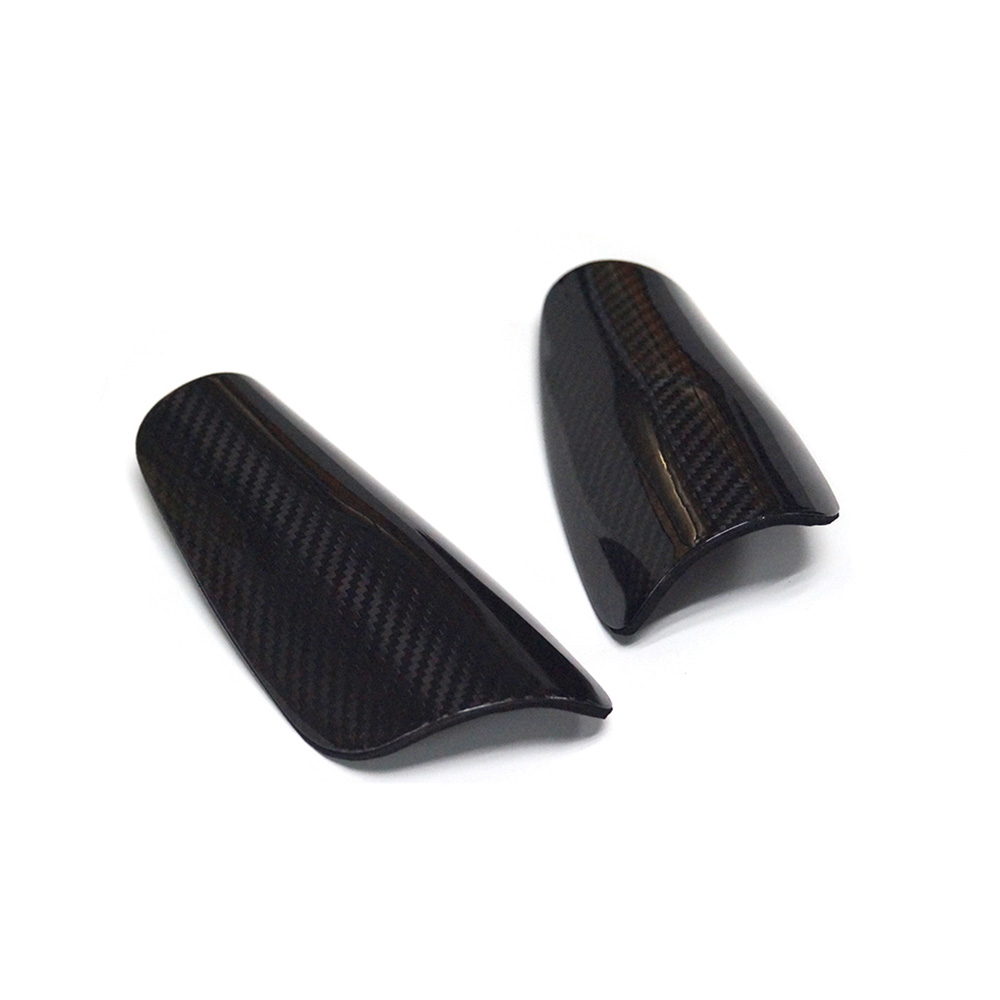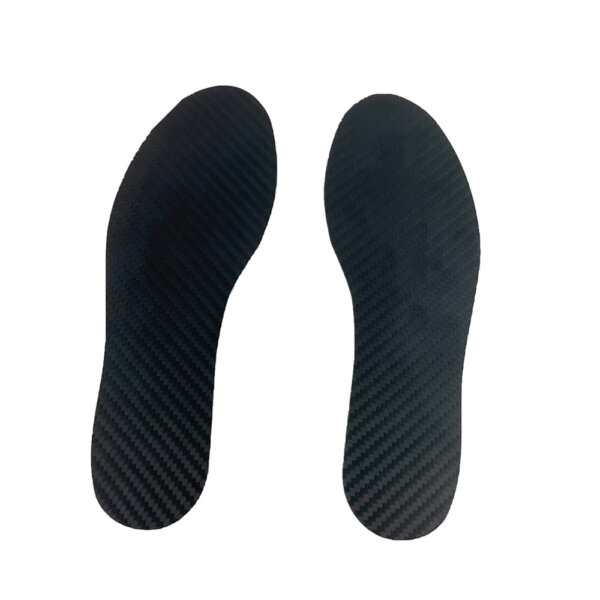

Short answer: Carbon fiber insoles can work, but not all of them work the same way, and not for the same purpose. A flat carbon fiber plate mainly limits how much your forefoot bends — a mechanism studied in clinical trials for conditions like first metatarsophalangeal (MTP) joint osteoarthritis, though the strength of that evidence is more mixed than it first appears (see below). A contoured carbon orthotic shell mainly adds arch support and stability. A performance insole mainly changes shoe stiffness during push-off, with effects that are measurable in some studies but small or absent in others. None of them are a substitute for medical treatment, and results depend heavily on plate thickness, curvature, fiber layup and the shoe it’s placed in — not just the fact that it’s “carbon fiber.”
This guide breaks down what peer-reviewed research has actually found, where carbon fiber insoles help, where the evidence is weaker or mixed, and what to look for before buying — or before speccing one into a product.
What Are Carbon Fiber Insoles?
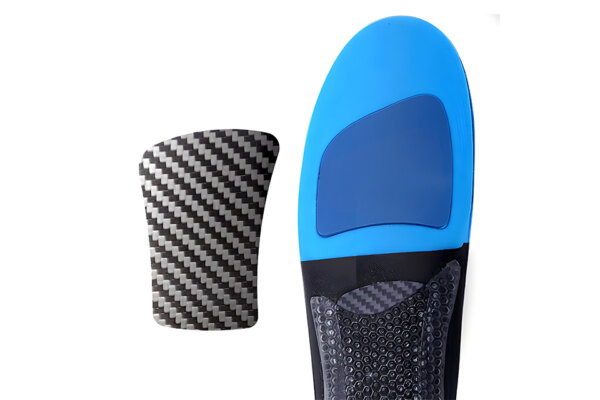
“Carbon fiber insole” is used loosely online to describe at least three different products — sometimes also marketed as carbon fiber foot inserts. Because these products serve different functions, treating them as interchangeable can lead to misleading comparisons.
| Type | What it is | Main function | Typical use case |
|---|---|---|---|
| Flat carbon plate | A thin, mostly flat sheet of cured carbon fiber laminate | Restricts forefoot (MTP joint) bending | Turf toe, hallux rigidus/first MTP joint osteoarthritis, forefoot stress injuries |
| Contoured carbon orthotic shell | Molded to the arch, sometimes with a heel cup | Arch support, motion control, load redistribution | Flat feet, overpronation, general orthotic support |
| Performance insole/plate | Full-length or 3/4-length plate, often paired with a cushioned top cover | Increases longitudinal shoe stiffness, alters push-off mechanics | Running, court sports, jumping |
A flat plate does not automatically give you arch support, and an orthotic shell does not automatically improve running economy — worth checking before assuming any “carbon fiber insole” does what you need.
How Do Carbon Fiber Insoles Actually Work?
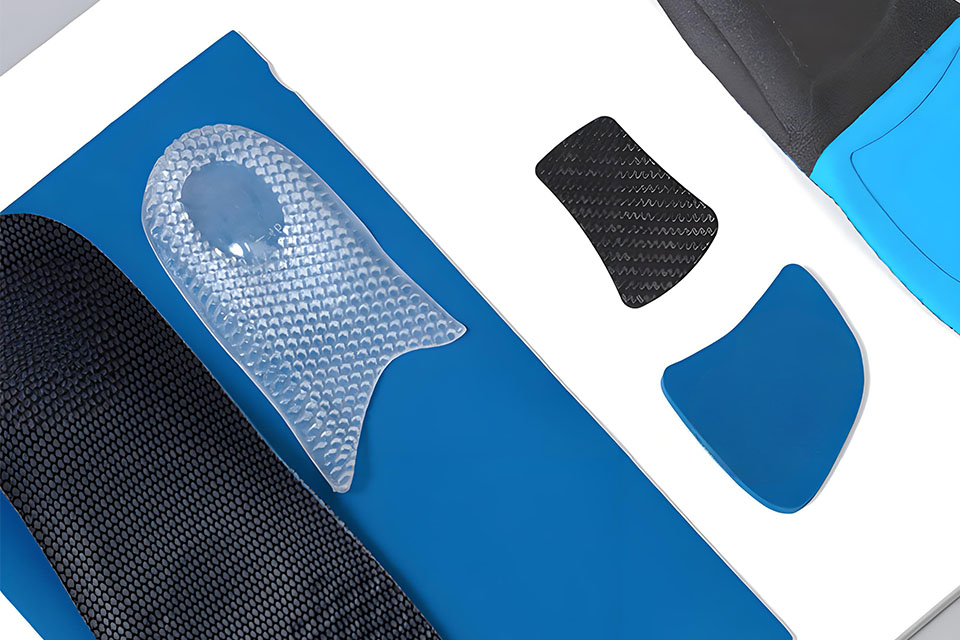
Carbon fiber doesn’t cushion the foot — it’s a structural material, not a shock-absorbing one. Comfort comes from the foam, gel, or fabric top layer bonded to it, not the carbon itself. What the carbon fiber layer does:
- Increases bending stiffness. A stiffer plate resists flexing at the metatarsophalangeal (MTP) joint, which is why stiffer plates are used where that motion causes pain.
- Limits localized joint motion. Restricting forefoot flexion can reduce the range of motion that aggravates certain forefoot injuries — a mechanical effect, not a healing one.
- Can alter plantar-pressure distribution. Depending on plate geometry, contour, footwear and activity, pressure may be reduced in some areas but increased in others — research on agility movements (below) found exactly this pattern.
- Changes shoe and MTP joint bending mechanics during push-off. This is the mechanism proposed for carbon-plated racing shoes, though whether it improves whole-body running efficiency depends on plate stiffness, geometry, running speed, the midsole foam, and the individual runner — a standalone insole in an ordinary shoe has not been shown to reproduce the effect (more on this below).
What Does the Research Actually Say?
This is the section most articles on this topic skip, replacing it with unsourced percentages. Below is what’s been published, with sample sizes included. Small studies can provide useful early evidence, but they should not be treated as proof that a product works for everyone.
Sports performance and comfort trade-off. A 2023 study in Sensors (Ko, Ma & Xiong, KAIST) tested 30 healthy young men wearing a carbon fiber insole versus a standard commercial insole. The carbon fiber insole improved power generation by about 1.5% and agility by about 1% — small improvements that reached statistical significance in this study. It also increased activation of the tibialis anterior and gastrocnemius muscles, and participants rated it as noticeably stiffer and less comfortable. In short: a modest performance gain came with a comfort cost, and the study didn’t test whether that trade-off holds up over a full training block.
Perceived vs. measured performance. A 2023 crossover study in the International Journal of Exercise Science (Dierickx et al., University of Connecticut) tested 15 moderately active men. There was no significant difference in vertical jump height, sprint distance, or oxygen consumption between the carbon fiber insole and a control insole. However, participants reported feeling more “propulsion” and believing they performed better while jumping. Because participants could tell which insole they were wearing, the authors noted that expectation bias may have influenced these subjective ratings — a useful reminder that perceived benefit and measured benefit aren’t the same thing.
Agility and cutting movements. A study in the Journal of Athletic Training tested 19 recreational athletes performing side-cut and crossover-cut agility tasks with a rigid carbon graphite footplate, originally proposed as a way to offload the fifth metatarsal during return from stress fracture. The footplate altered the pressure profile but was ineffective at reducing loading beneath the fifth metatarsal, and in some cutting tasks it increased peak pressure on the lateral midfoot and forefoot. This is a useful caution: a rigid plate doesn’t automatically reduce load exactly where you want it to.
First MTP joint osteoarthritis (hallux rigidus-type pain). The best-controlled clinical trial on this topic is a sham-controlled, blinded RCT (Munteanu et al., Osteoarthritis and Cartilage, 2021) of 100 adults with first MTP joint osteoarthritis, randomized to full-length carbon fiber shoe-stiffening inserts (n=49) or a sham insert (n=51), both alongside rehabilitation therapy. The trial’s own analysis found a statistically greater improvement in foot pain with the carbon fiber inserts at 12 weeks, though the authors noted the average difference was modest and not every participant experienced a clinically worthwhile improvement. A 2024 Cochrane systematic review that re-analyzed this same trial using GRADE methodology reached a more cautious conclusion: shoe-stiffening inserts probably lead to little or no difference in pain, function, or quality of life compared to sham inserts (moderate-certainty evidence), and probably show little or no difference in adverse events. This is a useful illustration of why a single trial’s own conclusion and a systematic review’s assessment of the same data can differ — and why “one positive trial” shouldn’t be read as settled proof.
Plantar fasciitis. A randomized clinical trial (Taseh et al., Foot & Ankle Surgery, 2024) compared carbon fiber (n=14), polyurethane (n=14), and polyethylene (n=17) insoles in 45 adults with plantar fasciitis. Both the carbon fiber and polyethylene groups showed statistically significant pain reduction, with the carbon fiber group improving starting around week 6 and the polyethylene group improving earlier, around week 2. With 14–17 participants per group, this is a reasonable early signal, not conclusive evidence that carbon fiber is the superior material for this condition.
Running economy in standard shoes. A 2024 randomized crossover study in Frontiers in Sports and Active Living (Engel et al.) tested 10 trained male runners using downward-curved carbon fiber insoles placed into conventional road racing shoes, compared to weight-matched control insoles. Running economy, maximal treadmill performance, 3-km time-trial performance, and most physiological and biomechanical measures showed no significant differences — and shoe comfort was rated significantly worse with the carbon fiber insoles. The authors suggested the running-economy benefits seen with integrated carbon-plated racing shoes likely depend on the combination of the plate with a specific high-energy-return midsole foam, not the plate alone — which directly supports an important distinction covered below: an aftermarket insole is not the same product as an integrated carbon-plated racing shoe.
Plantar pressure (computational modeling). Two related finite element modeling studies (Song et al.) simulated carbon fiber plates inside running shoes. One found that increasing plate thickness and moving the plate lower in the shoe stack reduced peak forefoot plantar pressure by as much as ~32% under certain simulated conditions. A follow-up study modeling plate curvature found that a curved plate design further reduced peak forefoot pressure compared to a flat plate of the same stiffness, by roughly 5–13% depending on the specific stiffness level modeled. These results come from computational running-shoe simulations, not measurements on individual aftermarket insoles across different foot types, so they shouldn’t be read as “curved insoles are always better.”
Bottom line on the evidence: carbon fiber insoles have a measurable mechanical effect on stiffness and motion control, small performance effects in some studies, and limited or mixed clinical evidence for first MTP joint osteoarthritis and plantar fasciitis. The evidence does not support treating carbon fiber as a universal fix — several studies found a stiffness-vs-comfort trade-off, and at least one found a rigid plate can increase pressure in an unintended location.
Potential Benefits
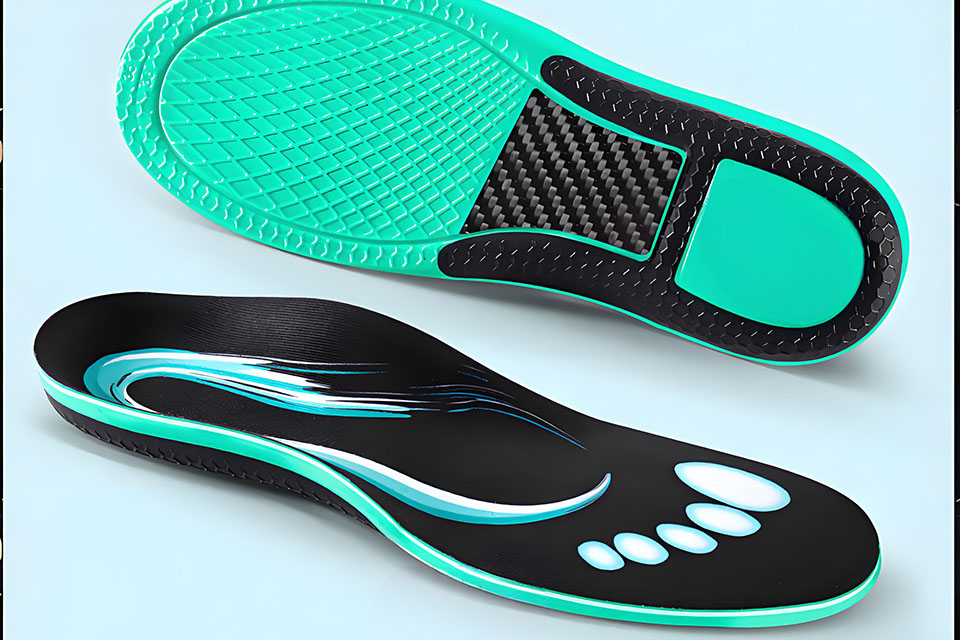
Based on the mechanisms and research above, carbon fiber insoles may offer:
- Increased longitudinal stiffness that limits painful forefoot bending
- A compression-resistant structural layer that generally retains its shape better than cushioning foams over time
- A thin profile that fits into low-volume athletic and dress shoes
- Modest gains in power and agility for some wearers, alongside a comfort trade-off
- A modest pain benefit reported in the original randomized trial for first MTP joint osteoarthritis, though a later systematic review rated the overall benefit as uncertain to small
- A stable base that can be paired with different top covers for different needs
Limitations and Drawbacks
Limitations are discussed less often than benefits in most product content, but they matter for anyone evaluating a rigid insole:
- Little to no inherent cushioning. Comfort depends entirely on the top-cover material bonded to the plate.
- Can feel harsh, especially on hard surfaces. Multiple studies found users rate rigid plates as less comfortable even when performance improves.
- May increase lower-leg muscle activation, which could matter for fatigue over longer sessions.
- Doesn’t always redirect pressure where you want it. In at least one study, a rigid plate increased pressure at the exact location (the fifth metatarsal) it was intended to offload.
- A flat plate is not an orthotic. A rigid, uncontoured plate does not provide arch support — that requires a shaped shell.
- Fit and trimming matter. A poorly trimmed edge can create a new pressure point rather than removing one.
- Not appropriate for every foot condition. Conditions involving reduced sensation generally call for professional fitting rather than a self-selected rigid insert.
- Higher upfront cost than foam, without a guaranteed proportional benefit for casual, non-injury use.
What Are Carbon Fiber Insoles Used For?
Carbon fiber inserts are frequently discussed for the following conditions. The right type, thickness, and rigidity should ideally be confirmed with a podiatrist, orthopedist, or physical therapist rather than chosen from a size chart:
First MTP joint osteoarthritis / hallux rigidus. This is one of the better-studied clinical uses of carbon fiber shoe-stiffening inserts — a blinded, sham-controlled RCT found a statistically significant improvement in pain at 12 weeks — although the average effect was modest, and a subsequent Cochrane systematic review rated the overall benefit on pain, function and quality of life as probably little to no different from a sham insert.
Turf toe and forefoot stress injuries. Limiting big-toe joint motion is a well-established mechanical rationale, typically used under clinical guidance during return-to-activity.
Plantar fasciitis. Early trial evidence is positive but modest, and not clearly superior to other insole materials tested in the same study.
Flat feet and overpronation. Only with a contoured orthotic shell — a flat plate does not provide arch support.
Return-to-sport after fifth metatarsal stress fracture. This is a common proposed use, but at least one controlled study found a rigid footplate did not reduce loading under the fifth metatarsal during agility movements, and in some cases increased it — a reason this application benefits from individualized clinical assessment rather than a generic insert.
Prolonged standing. Some users choose rigid or semi-rigid insoles for this purpose, but evidence specific to carbon fiber designs for this use case remains limited.
Who should be cautious: people with reduced foot sensation (for example, due to diabetes or impaired circulation) should seek professional fitting before using a rigid insert, since reduced sensation can delay noticing excessive pressure or skin irritation. Anyone whose pain worsens, or who develops numbness, after introducing a rigid insert should stop use and consult a professional rather than continuing through the break-in period.
Are Carbon Fiber Insoles Good for Running?
This depends on which of two different things is meant:
1. An aftermarket carbon fiber insole added to a regular running shoe. A 2024 controlled study found this did not improve running economy or maximal performance, and reduced comfort compared to a standard insole. A separate, smaller study found modest gains in power and agility with a comfort trade-off. Results appear to depend on plate design and how it’s tested.
2. An integrated carbon-plated “super shoe.” These are engineered as one system — plate curvature, rocker geometry, and highly resilient foam are tuned together. Running-economy improvements associated with racing super shoes come from that combined system, not the plate alone.
Dropping a standalone carbon insole into an ordinary trainer does not reproduce super-shoe performance, because it changes one variable in a system that was never designed around it.
Full-Length vs. 3/4-Length Carbon Fiber Insoles
| Factor | Full-length | 3/4-length |
|---|---|---|
| Forefoot motion control | Strongest | Limited — often doesn’t extend under the toes |
| Toe flexibility | More restricted | Toes retain more natural movement |
| Shoe compatibility | Needs more volume; may require removing the stock insole | Fits into tighter shoes and boots |
| Best for | Forefoot injury management, performance use | General stability, everyday comfort, dress shoes |
Carbon Fiber vs. Other Insole Materials
| Material | Structural stiffness | Cushioning | Durability (resists compression) | Typical role |
|---|---|---|---|---|
| Carbon fiber composite | High | Low without a top cover | High resistance to compression, though actual service life depends on laminate design, use, and impact | Motion control, structural support |
| Polypropylene | Medium–high | Low | Medium | Semi-rigid orthotic shells |
| EVA foam | Low–medium | High | Lower resistance to long-term compression than rigid composite shells | Cushioning, comfort |
| Polyurethane (PU) foam | Low–medium | High | Medium | Cushioning with more durability than EVA |
| Gel | Low (structural) | High (localized) | Medium | Pressure relief under specific areas |
“How much better” depends on the specific product’s thickness, curvature and top-cover pairing rather than the material label alone — which is exactly why the section below matters.
How to Choose the Right Carbon Fiber Insole
- Define the goal first: motion restriction (injury), arch support (orthotic), or energy return (performance) call for different plate geometries.
- Match length to your shoe. Full-length in athletic shoes with room to spare; 3/4-length for tighter or dress shoes.
- Don’t default to maximum rigidity. Stiffer isn’t automatically better — it’s a trade-off against comfort and, per the research above, increased calf/shin muscle activation.
- Check whether you need contour. If arch support is the goal, confirm the product is a shaped orthotic shell, not a flat plate.
- Expect a break-in period, and stop use if you notice numbness, sharp new pain, or new pressure points rather than relief.
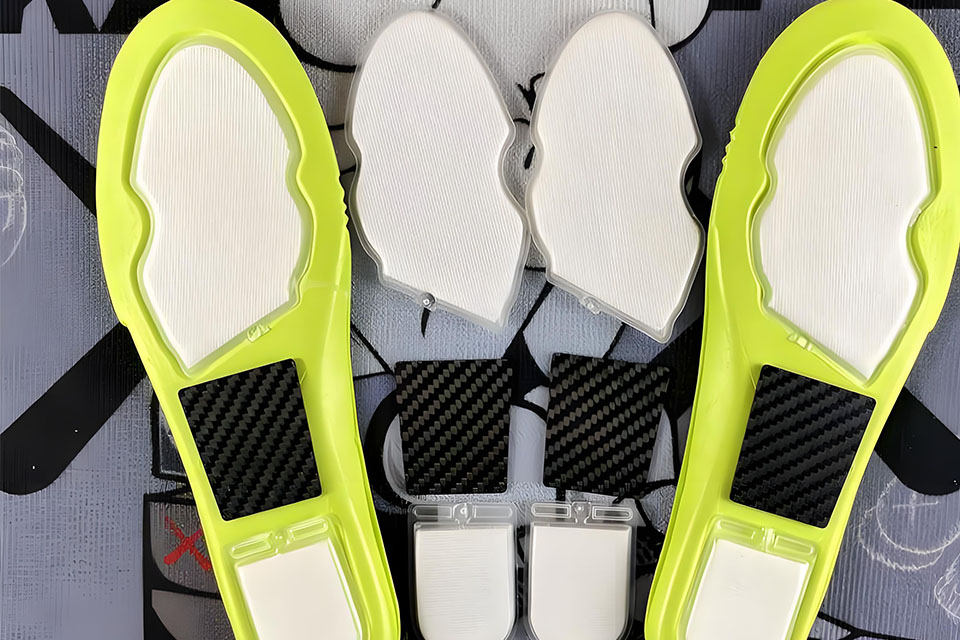
- For a diagnosed condition, get input from a podiatrist or physical therapist on thickness and rigidity rather than choosing by feel. Custom carbon fiber foot inserts can be developed around a customer-supplied geometry, target stiffness and intended application, whereas off-the-shelf products offer fewer design options.
Why Design Details Matter More Than the Label “Carbon Fiber”
This is where manufacturing detail, rather than marketing copy, determines whether an insole actually performs as intended.
Two insoles both labeled “carbon fiber” can behave very differently depending on:
- Fiber orientation. A layup oriented mainly along the length of the foot resists forefoot bending differently than a quasi-isotropic (multi-directional) layup — the same base material, tuned for a different job.
- Thickness. The relationship between thickness and stiffness is nonlinear; a small increase in thickness can make an insole feel substantially more rigid than the percentage increase in material would suggest.
- Curvature. As the modeling studies above indicate, plate curvature can meaningfully affect forefoot pressure distribution at a given thickness.
- Resin system, cure quality and laminate consolidation. These affect fatigue resistance, dimensional stability, and the risk of delamination under repeated flexing — along with factors like fiber content, void content, and layup structure.
- Bonding to the top cover. A poorly bonded foam layer can shift or delaminate — a common failure mode unrelated to the carbon fiber itself.
- Edge finishing. Sharp or poorly trimmed edges are a leading cause of new pressure points — a manufacturing detail, not a material one.
For footwear brands or orthotic developers evaluating carbon fiber insole components, these are the variables worth specifying and testing, rather than treating “carbon fiber” as a single, uniform spec.
Frequently Asked Questions
Are carbon fiber insoles worth it?
For specific goals — such as limiting forefoot motion or adding structural stiffness — the evidence suggests that some users may benefit, although results are not consistent and trade-offs are common. For general everyday comfort, foam or PU may be a better fit, since carbon fiber’s main advantage is structural stiffness rather than cushioning.
Do carbon fiber insoles help plantar fasciitis?
A randomized trial (n=45) found statistically significant pain reduction with carbon fiber insoles by around 6 weeks, similar in direction to polyethylene insoles which improved somewhat sooner. It’s a reasonable option to discuss with a professional, not a guaranteed fix.
Can carbon fiber insoles make you jump higher?
One controlled study found small measurable gains (roughly 1–1.5% in power and agility measures); another found no measurable jump-height difference but a strong perceived improvement. Expect a modest effect at most.
Are carbon fiber insoles comfortable?
Generally less so than foam, especially early on — multiple studies report they’re perceived as stiffer and firmer. Comfort mostly comes from the top-cover material, not the carbon layer.
How long do carbon fiber insoles last?
A well-made carbon fiber plate generally resists permanent compression better than foam or gel, which is the main durability advantage. However, its actual service life depends on laminate quality, body weight, activity level, footwear, and whether the plate experiences impact damage or delamination — and the cushioning top cover will usually wear out before the carbon structure does.
Are carbon fiber insoles good for flat feet?
Only if the product is a contoured orthotic shell with arch support — a flat, unshaped carbon plate does not provide arch support on its own.
Can you run in shoes with carbon fiber insoles?
Yes, but don’t expect “super shoe” level running-economy gains from an aftermarket insole alone — a 2024 study found no running-economy or performance benefit and reduced comfort when a carbon fiber insole was added to a standard running shoe.
Conclusion
Carbon fiber insoles can work — for specific, well-matched purposes. A flat plate restricting forefoot motion, a contoured shell adding arch support, and a performance insole altering push-off mechanics are three different tools solving three different problems, each with peer-reviewed evidence that is measurable but modest, and in at least one case, more mixed than a single positive trial suggests. The honest answer to “do they work” is: it depends on which type is used, for what, and how it’s built — thickness, fiber orientation, curvature, and top-cover material matter more than the words “carbon fiber” on the label.
For footwear and orthotic brands developing custom carbon fiber insole components, these design variables should be validated through prototyping and wear testing rather than assumed. The engineering team at ChinaCarbonFibers supports prototype development, laminate adjustment, and top-cover integration based on customer-supplied designs and performance requirements.
References
- Ko M, Ma T, Xiong S. Acute Effects of Carbon Fiber Insole on Three Aspects of Sports Performance, Lower Extremity Muscle Activity, and Subjective Comfort. Sensors. 2023;23(4):2154. doi:10.3390/s23042154
- Dierickx EE, Butler CR, Huggins RA, Zuk EF, Mason LC, DiStefano LJ, Casa DJ. Carbon Fiber Insoles Enhance Perception of Performance Despite Variable Objective Outcomes: Specific to the Moderately Active Individual. Int J Exerc Sci. 2023;16(4):885-897.
- Weinitschke A, et al. Plantar Loading During Cutting While Wearing a Rigid Carbon Fiber Insert. J Athl Train. 2014;49(3):297-303. doi:10.4085/1062-6050-49.2.16
- Munteanu SE, Landorf KB, McClelland JA, Roddy E, Cicuttini FM, Shiell A, Auhl M, Allan JJ, Buldt AK, Menz HB. Shoe-stiffening inserts for first metatarsophalangeal joint osteoarthritis: a randomised trial. Osteoarthritis Cartilage. 2021;29(4):480-490. doi:10.1016/j.joca.2021.02.002
- Munteanu SE, et al. Non-surgical interventions for treating osteoarthritis of the big toe joint. Cochrane Database Syst Rev. 2024;6:CD007809. doi:10.1002/14651858.CD007809.pub3
- Taseh A, Mathur V, Weaver B, Hashmi M, Vrolyk MA, Skolnik J, Ashkani-Esfahani S, Waryasz G. Role of insole material in treatment of plantar fasciitis: A randomized clinical trial. Foot Ankle Surg. 2024;30(6):524-528. doi:10.1016/j.fas.2024.04.006
- Engel FA, Zehnter F, Yona T, Mai P, Willwacher S, Düking P, Sperlich B. Acute physiological, biomechanical, and perceptual responses of runners wearing downward-curved carbon fiber insoles. Front Sports Act Living. 2024;6:1340154. doi:10.3389/fspor.2024.1340154
- Song Y, Cen X, Chen H, Sun D, Munivrana G, Bálint K, Bíró I, Gu Y. The influence of running shoe with different carbon-fiber plate designs on internal foot mechanics: A pilot computational analysis. J Biomech. 2023;153:111597. doi:10.1016/j.jbiomech.2023.111597
- Song Y, Cen X, Sun D, et al. Curved carbon-plated shoe may further reduce forefoot loads compared to flat plate during running. Sci Rep. 2024;14(1):13215. doi:10.1038/s41598-024-64177-3
This article explains material and product-design considerations for carbon fiber insoles and is not a substitute for diagnosis or treatment. If you have a diagnosed foot condition, persistent pain, numbness, or a recent injury, consult a podiatrist, orthopedic specialist, or physical therapist before choosing an insole.