Carbon fiber in race cars is valuable not simply because it reduces weight, but because it lets engineers control stiffness, strength, shape, and load paths. That distinction — between “carbon fiber is strong and light” and “carbon fiber lets engineers control where strength and stiffness go” — is what separates a superficial understanding of motorsport composites from an engineering one.
This article looks at carbon fiber in race cars from that engineering angle: how it affects weight distribution, structural stiffness, aerodynamic stability, safety, and part design — and where it has real limitations that marketing copy usually skips.
Key takeaways
- Carbon fiber improves racing performance through specific stiffness, weight placement, and aerodynamic stability — not weight reduction alone.
- Fiber direction, resin, core, inserts, and joints all determine part performance together, not the fiber alone.
- Structural, aerodynamic, and cosmetic racing parts require different design and validation standards.
- Carbon fiber isn’t always the best choice, especially for frequently damaged or high-temperature components.
Why Is Carbon Fiber Used in Race Cars?
High Stiffness at a Lower Structural Weight
Racing is not only about cutting total weight. Chassis, wings, and body panels also need to resist deformation under load, because excess flex changes aerodynamic surfaces, suspension geometry, and driver feedback. This is why racing engineers usually care more about specific stiffness (stiffness relative to weight) than about raw tensile strength. Carbon fiber composites offer a high specific stiffness and a level of design freedom that most metals cannot match.
Directional Strength Through Fiber Orientation
This is one of the most misunderstood aspects of carbon fiber. Metals are generally treated as roughly isotropic — they behave similarly no matter which direction a load comes from. A carbon fiber laminate is the opposite: it is strongly anisotropic. Fibers laid at 0°, 90°, and ±45° each serve a different structural role, and simply adding thickness in one direction does not automatically solve a torsion, shear, or local-load problem — fiber orientation directly determines the direction in which strength and stiffness are delivered.[1] The layup has to be designed around the actual load path.
| Fiber direction | Typical structural role |
|---|---|
| 0° | Main longitudinal tensile and bending loads |
| 90° | Transverse stability and load distribution |
| ±45° | Shear and torsional resistance |
| Local reinforcement | Inserts, mounting holes, and concentrated loads |
Complex Shapes Without Excessive Part Count
Racing components — wings, diffusers, ducting — often have complex curved geometry. Producing the same geometry in metal may require machining, forming, welding, or assembling several pieces, depending on the material and production volume. Composite construction can integrate a curved surface, internal stiffening, and sandwich core into fewer parts, reducing fasteners and the local stress issues that come with them.

Corrosion Resistance and Fatigue Considerations
Carbon fiber does not rust the way steel does, but that is not the same as saying it never degrades. Resin, bonded interfaces, hole edges, and impact-damaged zones still need inspection. Fatigue behavior in a composite part depends on layup, load direction, temperature, and manufacturing quality — carbon fiber is not a maintenance-free material.
How Carbon Fiber Improves Race-Car Performance
Acceleration and Braking
Lower mass reduces the inertia a car has to accelerate and decelerate, but the effect depends heavily on where the weight comes off. Rotating components, unsprung mass, and high-mounted mass do not behave the same way as static body panels. A 5 kg reduction in a roof panel does not influence the car in the same way as a 5 kg reduction in a wheel or a brake rotor.
Weight Distribution and Center of Gravity
This is a point most articles skip entirely. In categories with a minimum weight limit, cutting structural weight does not always make the finished car lighter overall — engineers may reinvest the weight savings as ballast, placed lower and more strategically in the chassis. So part of carbon fiber’s real value in regulated racing is not less weight, but more control over where weight sits.
Torsional Stiffness and Predictable Handling
Chassis torsion affects how the left and right suspension corners relate to each other. Adequate structural stiffness makes suspension tuning more predictable — but “stiffer is always better” is not entirely accurate either. The goal is meeting the specific vehicle’s design targets without adding unnecessary weight or brittleness.
Aerodynamic Shape Stability
Front wings, rear wings, floors, and diffusers all carry aerodynamic loads. A surface that visibly deflects at speed can change the angle of attack or airflow path underneath it. Aerodynamic composite parts need to be stiff in specific directions, not just light — a thin panel with the wrong layup can look intact while still deforming meaningfully at high speed.
Thermal Management Around Brakes and Exhausts
Parts near brakes, turbos, and exhausts can’t be specified by fiber type alone. The resin’s glass transition temperature and continuous-use temperature matter, and these zones sometimes need insulation layers, reflective films, air gaps, or a different material entirely. The resin used on a cosmetic exterior panel is often not suitable for a high-heat racing zone.
Which Race-Car Parts Are Made From Carbon Fiber?
Primary Structural Components
This category includes the monocoque or survival cell, structural tubs, certain suspension-related structures, bulkheads, and energy-absorbing structures. These are high-responsibility parts requiring structural calculation, material validation, defined manufacturing process control, and testing — they are not built with the same assumptions as a cosmetic exterior part. Structural design at this level is closely tied to overall carbon fiber chassis engineering because the monocoque forms the primary load-bearing structure in many modern race cars.
Aerodynamic Components
Front wings, rear wings, splitters, diffusers, undertrays, canards, and air/brake ducts fall here. For these parts, shape accuracy matters as much as stiffness. Sandwich construction often improves bending stiffness, mounting points and end-plate junctions usually need local reinforcement, and vibration plus curb-strike impact both have to be accounted for in the design.
Body Panels and Access Panels
Hoods, roofs, doors, fenders, engine covers, and access panels are often treated primarily as body or closure components, although their structural role varies by vehicle design and racing category. Priorities here often shift toward weight, surface quality, quick-release capability, dimensional stability, and ease of service — a racing panel is not always designed the same way as a decorative street-car panel.
Cockpit and Interior Racing Components
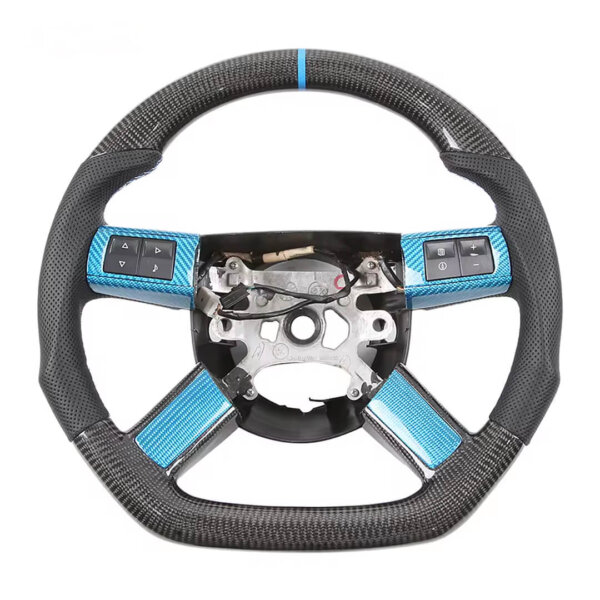
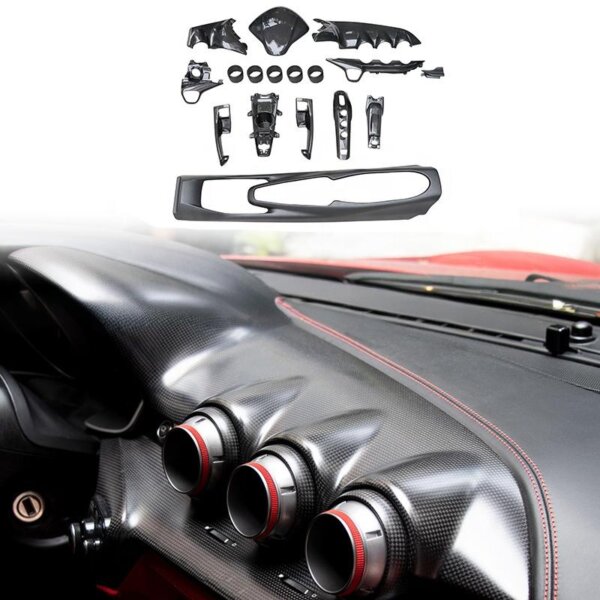
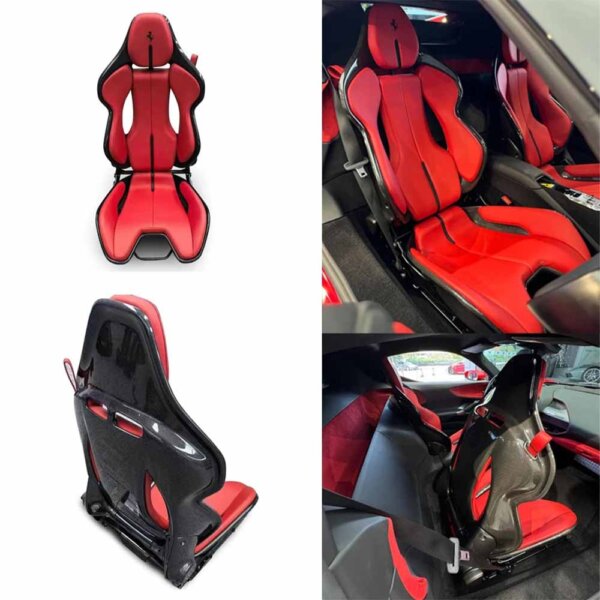
Carbon fiber racing seats, dashboards, instrument panels, control enclosures, steering-wheel structures, and driver-interface components belong in this group. It’s worth being clear that decorative interior trim and structurally critical cockpit components are not the same category of part, even though both are described as “carbon fiber.”
Carbon-Carbon Braking Components Are Different
Racing carbon-carbon brake discs are not conventional epoxy-based CFRP components. Their carbon matrix and high-temperature processing make them a separate material category from carbon fiber body panels, and “carbon fiber body parts” and “carbon-carbon brakes” should not be treated as the same material.
Carbon Fiber Doesn’t Work Alone: The Complete Composite System
Fiber Grade
Standard-modulus, intermediate-modulus, and high-modulus fibers each suit different parts. A higher grade is not automatically the right choice for every component — higher-modulus material can improve stiffness, but design, cost, and damage tolerance all have to be weighed together.
Resin System
The resin transfers load, protects the fibers, and holds the geometry. Temperature resistance, toughness, moisture behavior, and process compatibility all matter. Naming the fiber brand alone doesn’t define part quality — the same fiber paired with a different resin and process can produce meaningfully different final performance.
Core Materials
Sandwich cores exist to increase bending stiffness, manage weight, maintain thin curved surfaces, and support local loads. Structural foam, aluminum honeycomb, and aramid honeycomb are all common choices — but there is no single “best” core independent of the application.
Adhesives, Inserts, and Edge Reinforcement
Many racing part failures don’t happen in the broad laminate area — they happen at bolt holes, metal inserts, bonded edges, thin edges, and load-introduction points. Metal inserts need to account for pull-out resistance, crush behavior, local delamination, and galvanic isolation from the carbon fiber. Hole edges typically need local reinforcement or a properly designed load-spreading detail. These details are also where differences in engineering review, process control, and manufacturing consistency often become most visible.

How Motorsport Carbon Fiber Parts Are Designed and Manufactured
Define the real load case. Before any layup is designed, engineers need aerodynamic load, impact risk, vibration, mounting loads, heat exposure, stiffness targets, dimensional tolerances, and expected service life. A visually accurate CAD model is not enough on its own to define a structural racing component.
Select the laminate and core. This covers choosing solid laminate versus sandwich panel, balanced and symmetric layups where appropriate, local reinforcement, fiber continuity, and how joints and interfaces are handled.
Design for manufacturing. Overly deep negative-draft features, very small radii, closed sections, tight areas that are hard to lay up, zones where a vacuum bag or bladder can’t be placed, and impractical trim lines or insert locations all create downstream problems — bridging, wrinkling, resin pooling, uneven thickness, demolding issues, and dimensional instability.
Choose the manufacturing process. Prepreg and autoclave suit parts needing high fiber volume fraction, low porosity, stable thickness, and high surface or structural requirements — typically smaller-batch, high-performance components. Resin infusion works well for larger racing panels or cost-sensitive projects; with a well-designed mold and process, infusion can deliver good quality and shouldn’t be dismissed as a “lower quality” method by default. Compression molding suits higher-volume repeat production, with a larger tooling investment, and fits certain small-to-mid-size parts depending on geometry and material system. Note that “autoclave carbon fiber” is not, by itself, a quality guarantee — final quality still depends on material storage, layup accuracy, vacuum integrity, cure cycle, mold stability, insert and core handling, cutting accuracy, and inspection standards. (For a full breakdown of these steps, see our guide on how to make carbon fiber car parts.)
Validate before full production. This typically includes first-article inspection, fitment checks, dimensional inspection, weight recording, visual inspection, tap testing or more advanced NDT methods depending on geometry and criticality, and proof loading or destructive testing for critical parts. Not every racing part needs the same level of testing — the validation scope should match the part’s responsibility level.
Factory Example: Why a Small Internal Radius Matters
In one custom motorsport component, the customer specified a thick laminate around a very small internal radius. The outer CAD surface was achievable, but the inner geometry left insufficient space for the laminate to conform and compact properly. Keeping the original design would have increased the risk of bridging, trapped air, resin-rich corners, and uneven internal surfaces. The practical solution was to increase the internal radius and revisit the local laminate schedule, rather than simply applying more pressure during molding.
How Carbon Fiber Improved Race-Car Safety
Survival Cells
The carbon fiber monocoque forms the main protective structure around the driver. Modern motorsport safety doesn’t rely on material alone — it depends on structural design, crash testing, and surrounding energy-absorbing structures working together. McLaren’s MP4/1 in 1981 is widely regarded as the turning point where Formula 1 shifted decisively toward composite monocoque construction, and F1’s own safety history credits the carbon fiber survival cell as central to protecting drivers in serious impacts.[2]
Controlled Energy Absorption
Safety structures aren’t simply “as rigid as possible.” The survival cell needs to stay intact, while front, rear, and side impact structures are designed to fail and absorb energy in a controlled way. Layup design, trigger structures, and geometry all determine how carbon fiber performs in a crash — peer-reviewed research on composite fracture behavior shows that crash performance depends on how the laminate is engineered to fail, not on the material name alone.[3]
Hybrid Reinforcement
Some zones combine carbon fiber with aramid or other materials to improve puncture resistance and control debris. Carbon fiber, aramid, and other reinforcements aren’t interchangeable substitutes — they perform different roles within the same structure.
Testing Matters More Than Marketing Claims
High-responsibility racing parts need to pass defined tests. Terms such as “aerospace-grade,” “F1-grade,” and “race-grade” do not, by themselves, define a complete material or quality specification. A credible supplier should be able to specify the actual material, layup, process, inspection, and validation behind a part — not just the label on it.
For safety-critical structures, laminate design, simulation, crash performance, and certification should be defined or approved by a qualified motorsport composite engineer. The engineering principles in this article are general guidance; structural and safety-critical racing parts require project-specific design, calculation, testing, and compliance with the applicable motorsport regulations.
The Limitations of Carbon Fiber in Motorsport
Hidden impact damage. The visible surface may show only minor damage while the interior develops delamination, core debonding, or local crushing. A glossy, intact-looking surface is not proof of structural soundness.
Difficult inspection and repair. Repairing a structural part means first establishing the true extent of the damage — a cosmetic patch is not the same as a structural repair that restores the original load path. Whether a high-responsibility part can be repaired at all often depends on the design spec and the event’s technical regulations.
Higher tooling and labor cost. Costs come from mold development, hand layup labor, material storage and shelf-life management, curing, inspection, scrap risk, and low production volumes.
Galvanic corrosion with metals. Direct contact between carbon fiber and metals like aluminum, in the presence of an electrolyte (including rainwater), can create a corrosion risk. Isolation layers, coatings, adhesives, and drainage all need to be considered at the design stage — this matters a great deal for a car that gets rained on and washed regularly.
Brittleness and debris. Carbon fiber fails differently than a metal that deforms plastically — it can crack and produce sharp-edged fragments. Depending on the zone, this can call for tougher resin, aramid hybridization, or a design specifically intended to resist shattering.
Carbon Fiber vs Aluminum, Steel, and Fiberglass in Race Cars
Material selection also depends on whether the application is a structural laminate, an aerodynamic component, or an automotive body panel. For a broader comparison of properties, advantages, limitations, weight, and cost, see our guide to CFRP automobile body panels.
| Material | Main racing advantages | Main limitations | Typical suitability |
|---|---|---|---|
| Carbon-fiber composite | High specific stiffness, directional design, complex shapes | Cost, impact inspection, repair complexity | Aero surfaces, bodywork, structures |
| Aluminum | Machinable, ductile, easier to inspect | Lower specific stiffness for some structures | Brackets, frames, housings |
| Steel | High toughness, weldable, low material cost | Higher density | Roll structures, mounts, fixtures |
| Fiberglass | Lower cost, good impact tolerance, RF-transparent | Lower stiffness than CFRP | Covers, prototypes, non-critical panels |
| Aramid composite | Impact and penetration resistance | Difficult machining, compression limitations | Hybrid reinforcement, protection zones |
The best race car isn’t the one with the most carbon fiber in it. It’s the one that uses each material where its specific properties provide a measurable advantage.

When Does a Motorsport Project Actually Need Carbon Fiber?
Carbon fiber tends to make sense when:
- Structural weight or stiffness is a clear bottleneck
- Aerodynamic surfaces need low deflection under load
- A complex curved shape is hard to achieve efficiently in metal
- Center of gravity or weight distribution has a defined target
- Production volume and budget support dedicated tooling
- The project has a clear validation and testing plan
Carbon fiber isn’t always the right call when:
- Only a single early-concept part is being produced
- The design is still changing frequently
- Weight savings wouldn’t translate into a real performance gain
- The part crashes often and needs to be cheap and quick to replace
- The operating temperature exceeds what the resin system can handle
- The requirement is purely cosmetic and fiberglass or an aluminum part already does the job
What Information Does a Manufacturer Need for a Racing Part?
A complete quotation and design review typically needs: 3D CAD files (STEP/STP preferred), key 2D dimensions and tolerances, the part’s function, whether it’s structural, load direction and magnitude, temperature range, mounting points and insert requirements, target weight, surface requirements, expected quantity, testing/inspection requirements, event or internal technical regulations, any existing sample, mold, or scan data, and whether the geometry can be adapted for composite manufacturing.
From our manufacturing experience: many motorsport enquiries include a complete outer-surface CAD model but omit load data, laminate requirements, insert details, temperature limits, and inspection criteria. This may be sufficient for a non-structural appearance panel, but it is not enough to quote or manufacture a safety-critical component responsibly.
Practical Design Lessons From Custom Motorsport Projects
A thicker laminate isn’t automatically a better laminate. Adding thickness blindly increases weight, may fail to address a load coming from the wrong direction, and can introduce resin pooling, wrinkling, and cure problems. Fixing the fiber orientation, adding a core, or adding local reinforcement is usually the better answer.
Tight corners need composite-specific geometry. Small internal radii tend to cause fiber bridging, and thick layups are hard to compact in narrow zones. Radii, parting lines, pre-forming, or internal pressure methods often need to be adjusted specifically for composite tooling.
Inserts often determine whether the part succeeds. Load concentrates around threaded inserts, so adequate local bearing and pull-out resistance are essential — insert placement also affects final assembly accuracy.
Cutting accuracy can matter as much as molding accuracy. Even a geometrically accurate molded part can cause fitment problems if trim lines, drilled holes, or datum locations are wrong. Fixtures, CNC trimming, or reliable locating datums help avoid this.
Surface quality is not structural quality. A clean weave pattern and a glossy clear coat don’t prove low porosity, correct layup, or good bonding. Structural racing parts should be verified against engineering requirements — visual inspection is only one part of quality control.
Frequently Asked Questions
Why is carbon fiber used in race cars?
For its combination of high specific stiffness, directional design capability, and the ability to form complex aerodynamic surfaces and safety structures at a lower weight than most metals.
Does carbon fiber make a race car faster?
Not automatically — it depends on where the weight is removed, how stiffness is designed into the part, aerodynamic behavior, and the overall vehicle setup.
Are race cars made entirely from carbon fiber?
No. Most race cars still use aluminum, steel, titanium, magnesium, aramid, rubber, and other materials alongside carbon fiber.
What race-car parts are commonly made from carbon fiber?
Monocoques, wings, diffusers, floors, body panels, ducting, and racing seats are among the most common.
Is carbon fiber stronger than steel?
It depends on direction, density, thickness, load type, and structural design — a direct comparison without those factors isn’t meaningful.
Can damaged race-car carbon fiber be repaired?
Some damage can be repaired, but the extent of the damage needs to be assessed first, and safety-critical structures may be restricted by repair regulations.
Is dry carbon better for racing?
“Dry carbon” generally refers to the prepreg process, but final quality still depends on the material, layup, cure, mold, and inspection — not the label alone. See our what is dry carbon fiber page for a full comparison with wet carbon.
Is forged carbon suitable for race cars?
It can work for certain complex shapes or molded parts, but shouldn’t be assumed to be a direct substitute for traditional continuous-fiber laminate just because of its appearance or name.
What CAD files are required for a custom racing part?
STEP/STP files are preferred, along with tolerances, load data, insert requirements, surface specification, and quantity.
How much do custom carbon fiber racing parts cost?
Cost depends on part size, structural responsibility, tooling, process, material, inspection, and quantity — there’s no single universal number. See our carbon fiber cost guide for typical price ranges by part type.
Conclusion
Carbon fiber changed racing, but not simply because it is light. Its real value is that it lets engineers control stiffness, strength, shape, and where weight sits in the car. Different racing components need different material systems and layups, and getting a high-quality composite racing part requires design, manufacturing, and validation working together — not every part is a good candidate for carbon fiber in the first place.
For a custom motorsport component, provide the STEP model, intended function, load information, temperature range, mounting details, target quantity, and inspection requirements. These details let a manufacturer evaluate whether the part should use a solid laminate, sandwich construction, prepreg autoclave process, or another composite solution entirely. You can also explore our carbon fiber car parts category for examples of existing applications, vehicle projects, and custom manufacturing capabilities.
Technical Sources
- Racecar Engineering, “Tech Explained: Carbon Fibre Prepreg,” February 2, 2018.
- Formula 1, “5 Crucial Milestone Moments in F1 Safety Technology,” May 14, 2025.
- G. Savage, I. Bomphray, and M. Oxley, “Exploiting the Fracture Properties of Carbon Fibre Composites to Design Lightweight Energy Absorbing Structures,” Engineering Failure Analysis, Vol. 11, Issue 5, pp. 677–694, ScienceDirect, 2004.