Carbon fiber cracks can range from a minor clear coat blemish to deep structural fractures that compromise the integrity of the part. Before starting any repair, the critical first step is identifying which type of damage you are dealing with — because the repair process, the risk level, and the decision between DIY and professional repair are all different.
For non-load-bearing cosmetic parts, small cracks can often be repaired at home with epoxy resin, carbon fiber cloth, and clear coat refinishing. For structural components — bike frames, load-bearing brackets, racing parts, UAV arms, or safety-critical motorcycle components — the part must be inspected by a composite professional before use.
As a carbon fiber manufacturer with 28+ years of experience supplying automotive, motorsport, UAV, industrial, and custom composite customers, we have inspected and repaired thousands of cracked carbon fiber parts. This guide covers everything: how to identify the damage type, the right repair method for each, common mistakes, and when replacement is the safer option.
Can Cracked Carbon Fiber Be Repaired?
Yes — in many cases, cracked carbon fiber can be repaired effectively. A properly executed repair using the correct epoxy system, matched carbon fiber weave, and adequate cure time can restore significant structural integrity to a damaged part.
However, not all damage is repairable to the same standard:
- Clear coat and surface resin cracks are almost always repairable at home with basic tools.
- Matrix cracks (resin cracked, but fibers still intact) can usually be repaired with epoxy injection and a backing patch.
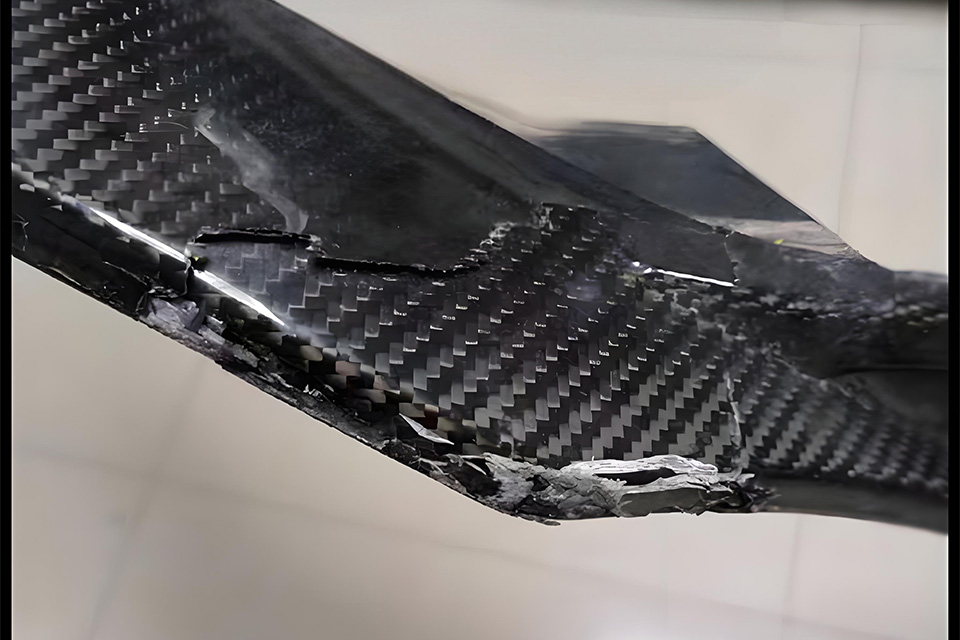
- Broken fibers, delamination, or crushed carbon require professional composite repair or part replacement, especially on structural components.
The repair will generally not restore 100% of original strength — which is why the damage type, the part’s function, and the safety context all matter before deciding whether to repair or replace.
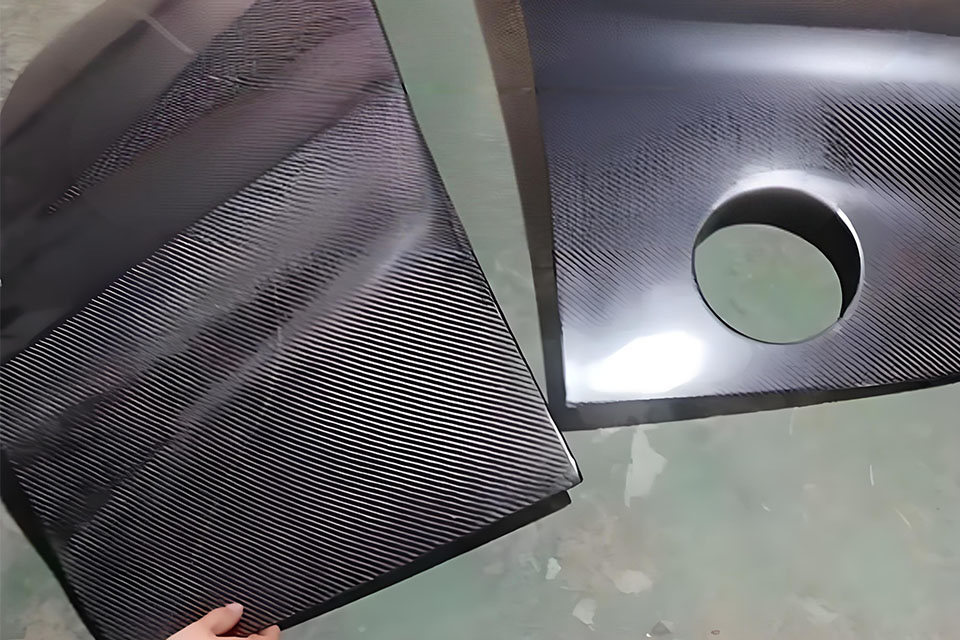
Clear Coat Crack vs Structural Carbon Fiber Crack
Understanding the damage layer is the most important diagnostic step.
| Damage type | What it looks like | Fibers intact? | DIY repairable? | Risk level |
|---|---|---|---|---|
| Clear coat crack | Crack only in the glossy top layer, no discoloration below | Yes | Yes | Low |
| Matrix / resin crack | Crack visible below clear coat, slight whitening, but no fiber separation | Yes | Usually | Medium |
| Delamination | Hollow sound when tapped, cloudy or raised surface | Partially | Inspect first | High |
| Broken fibers | Visible fractured carbon strands, soft spot, part flexes abnormally | No | Not recommended | High |
| Crushed carbon | Grey-white fractured zone, visible deformation, impact point | No | Replace or professional repair | Very high |
How to Inspect Carbon Fiber Crack Damage
Accurate damage assessment prevents wasted repair effort and avoids using a structurally unsafe part.
Visual inspection
Examine the full surface under strong, angled light. Look for:
- Hairline fractures in the clear coat or resin layer
- White or cloudy discoloration — this usually indicates that the resin matrix has fractured and layers may be starting to separate
- Raised or buckled surface — a sign of delamination underneath
- Soft spots or abnormal flex when light pressure is applied
Tap test
The tap test is a reliable method for finding hidden delamination. Use a coin or small metal rod and gently tap across the surface in a grid pattern.
- A sharp, clear sound indicates the laminate is solid and bonded.
- A dull, hollow thud indicates delamination — the separated layers absorb vibration differently than a solid laminate.
Compare the suspect area against a known-good area on the same part to establish the reference sound.
When to get professional NDT assessment
If you suspect internal delamination but cannot confirm it visually or by tap test, a composite repair specialist can perform ultrasonic testing or thermographic inspection to map the damage without further disassembly. This is strongly recommended for bike frames, UAV arms, structural brackets, motorcycle components, and any part where failure would be a safety risk.
Tools and Materials for Carbon Fiber Crack Repair
Having the right materials makes the difference between a repair that holds and one that fails within weeks.
Required tools:
- Wet/dry sandpaper: 120, 240, 400, 600, 1000, 1500, 2000 grit
- Low-viscosity epoxy resin with appropriate hardener (e.g., West System 105/205 or 105/206)
- 3K carbon fiber cloth in matching weave (plain or 2×2 twill)
- Isopropyl alcohol (90%+) for surface preparation
- Mixing cups and stir sticks
- Gloves, safety glasses, dust mask
- Peel ply and release film (for patch repairs)
- Polishing compound and UV-resistant clear coat
Why epoxy, not polyester resin: Polyester resin bonds poorly to cured carbon fiber. Always use a structural epoxy system for carbon fiber crack repair. Polyester is acceptable for fiberglass — not for carbon.
How to Identify Which Repair Method You Need
| Damage type | Recommended repair method |
|---|---|
| Clear coat crack only | Sand, fill with clear coat or thin epoxy layer, re-clear |
| Resin/matrix crack, fibers intact | Epoxy injection or surface fill + carbon fiber backing patch |
| Delamination (limited area) | Professional inspection recommended before DIY |
| Broken fibers (cosmetic part) | Carbon fiber patch on back face + surface refinishing |
| Broken fibers (structural part) | Professional composite repair or replacement |
| Crushed or heavily impacted | Replace or send to professional repair facility |
How to Repair a Small Carbon Fiber Crack (Clear Coat or Matrix)
This method applies to surface-level cracks where the fibers are intact.
Step 1: Assess and clean the area
Wash the part with mild soap and warm water. Dry completely, then wipe the repair area with isopropyl alcohol to remove all wax, silicone, and contamination. Allow to dry fully before sanding.
Contamination under the repair is one of the most common causes of repair failure. Do not skip this step.
Step 2: Sand the repair zone
Using 120 or 180 grit wet sandpaper, sand an area approximately 25–30mm around the crack to create a mechanical key for the epoxy. Sand in a circular motion.
Stop immediately if you see black dust. Black particles mean you have sanded through the resin matrix and are cutting into the carbon fibers. You want to sand only to the resin surface, not into the fiber layers. If you reach bare fibers, the repair scope changes and a backing patch is required.
Step 3: Apply epoxy resin
Mix the epoxy and hardener according to the manufacturer’s ratio. Incorrect mixing ratios can produce a soft, poorly cured repair with significantly lower strength than the epoxy system is designed to achieve. Stir thoroughly for the recommended time.
Apply a thin first coat over the crack and the prepared zone. Work the resin into the crack with a stiff brush or squeegee to ensure penetration. Remove air bubbles by running the brush lightly over the surface.
Apply 2–3 coats in total, allowing each coat to reach a gel state before applying the next.
Step 4: Cure fully
Follow the epoxy manufacturer’s cure schedule. Most room-temperature epoxy systems require 24 hours before sanding and 72 hours for full strength. Elevated temperature post-cure (e.g., 60°C for 4 hours) significantly improves final properties if your part can withstand it.
Step 5: Sand and refinish
Once fully cured, wet sand progressively: 400 → 600 → 1000 → 1500 → 2000 grit. Keep the sandpaper wet throughout.
Apply UV-resistant automotive clear coat in 2–3 light coats. Wet sand the final clear coat with 2000 grit and polish with a machine polisher or hand compound.
How to Repair Cracked Carbon Fiber With a Carbon Fiber Patch
Use this method when fibers are broken, the crack is structural, or you need to restore strength rather than just cosmetic appearance.
Prepare the back face
Where possible, work from the back (non-visible) face of the part. This allows you to build up the reinforcing patch without affecting the visible surface finish.
Sand the back face in a 50–80mm radius around the crack location. Clean with isopropyl alcohol.
Cut and orient the patch plies
Cut carbon fiber cloth into pieces sized to cover the damaged area plus a minimum 25mm overlap on all sides. For structural repairs, use multiple plies:
- Cosmetic parts: 2 plies is usually sufficient
- Semi-structural parts: 3–4 plies
- Structural parts: Consult a composite engineer — ply count, fiber orientation, and overlap length are calculated against the original design load
For best strength restoration, orient the patch plies at 0°/90° and ±45° to match the original laminate direction if known.
Apply the wet layup
Apply a layer of mixed epoxy to the prepared back face. Place the first ply of carbon cloth and wet it out thoroughly with epoxy, pressing out air bubbles with a squeegee or roller. Repeat for each ply.
Apply peel ply over the final ply and consolidate the stack with a squeegee. Peel ply removes the need for heavy sanding and leaves a bondable surface.
Cure and finish the front face
After the patch has cured, address the front face cosmetically: fill the crack line with thin epoxy or spot filler, sand flat, and apply clear coat.
How to Fix Chipped Carbon Fiber Edges
Edge chips are common on carbon fiber hoods, spoilers, side skirts, and fairings — areas exposed to stone chips, abrasion, or minor impacts.
- Clean the chipped area thoroughly with isopropyl alcohol.
- If carbon fibers are exposed, apply a small amount of thin (low-viscosity) epoxy to re-wet and stabilize the fiber ends.
- Once cured, build up the edge profile with body filler or filled epoxy paste (not polyester filler — use an epoxy-based product).
- Sand flush, prime, and clear coat.
For large edge chips where a significant section of the laminate has separated, a bonded carbon fiber edge reinforcement is a more durable solution than filler alone.
When You Should Not Repair Carbon Fiber Yourself
Safety note: This guide is for general repair education. For load-bearing or safety-critical carbon fiber parts, always follow the original manufacturer’s repair instructions or consult a qualified composite repair specialist.
DIY repair is appropriate for cosmetic and lightly damaged parts. There are situations where self-repair is inadvisable:
- Bicycle or motorcycle frames with any fiber fracture — frame failure at speed is a life-safety risk
- Structural brackets, UAV arms, motorcycle parts, or chassis-related components — these have design loads and repair standards that require engineering sign-off
- Parts with widespread delamination — delaminated areas are difficult to re-bond reliably without vacuum equipment and proper surface preparation
- Parts where the original laminate specification is unknown — matching ply count and orientation without the original data means you cannot guarantee the repaired strength
- Any part where you are unsure after inspection — when in doubt, have it inspected professionally
Carbon Fiber Crack Repair vs Replacement
A repair restores partial strength. A new part restores 100%. The decision depends on the part’s function, the damage severity, and the relative cost.
| Factor | Repair | New OEM-spec part |
|---|---|---|
| Strength recovery | Partial — depends on damage type, layup design, and repair quality | 100% |
| Cost | Lower upfront | Higher upfront, lower long-term risk |
| Appropriate for | Cosmetic and non-critical parts | Structural and safety-critical parts |
| Appearance | May show repair line depending on method | Matches original finish |
| Turnaround | Hours to days | Days to weeks (custom manufacturing) |
| Risk | Repair quality depends on execution | Known manufacturing standard |
As a manufacturer, we can produce replacement and custom carbon fiber parts to the same specification as the original — or improve on it with better resin systems, UV-resistant clear coat, or reinforced layup in high-stress areas.
Common Mistakes When Repairing Carbon Fiber
Inadequate surface preparation. Wax, silicone, oil, and water contamination prevent epoxy from bonding to the carbon substrate. Clean the surface thoroughly and allow it to dry completely before applying any resin.
Wrong resin system. Polyester resin does not bond reliably to cured epoxy carbon fiber. Use a structural epoxy resin.
Incorrect mix ratio. Epoxy systems require precise volumetric or weight ratios. Off-ratio mixes do not cure properly and produce a soft, weak repair.
Sanding too deep. Sanding into the fiber layers weakens the laminate and turns a cosmetic repair into a structural one.
Insufficient cure time. Room-temperature epoxy systems continue to develop strength for 72 hours or more. Sanding too early produces a soft surface and risks pulling material out of the repair.
Using fiberglass cloth on a carbon fiber part. Fiberglass has a lower stiffness modulus than carbon fiber. A fiberglass patch on a carbon part creates a stiffness discontinuity that concentrates stress at the patch boundary and can cause secondary failure.
Skipping the tap test after repair. After the repair cures, re-tap the area. Any hollow sound indicates voids in the repaired zone that will eventually cause delamination.
FAQ About Carbon Fiber Cracks
Does carbon fiber crack?
Yes. Carbon fiber is strong in tension and compression along the fiber axis, but it is brittle under out-of-plane impact, point loading, or repeated fatigue cycles. Cracks can result from impact damage, overloading, poor installation, drilling damage, UV degradation of the resin matrix, or thermal cycling.
Can you repair carbon fiber?
Clear coat cracks and surface resin cracks can generally be repaired at home. Matrix cracks with intact fibers can be repaired with epoxy injection and a backing patch. Broken fibers and delamination on structural parts should be assessed professionally before repair or use.
How do you repair a carbon fiber crack?
The process depends on crack type: clean and prep the surface, remove damaged resin, apply low-viscosity epoxy resin (and a carbon fiber patch if fibers are involved), cure fully, then sand and refinish. Full details are in the step-by-step sections above.
Is cracked carbon fiber safe to use?
A cracked decorative trim piece with no structural function may remain usable after cosmetic repair. A cracked bike frame, structural fairing bracket, or load-bearing automotive component is not safe to use until professionally inspected and repaired or replaced.
What is the difference between chipped carbon fiber and cracked carbon fiber?
A chip is localized surface or edge damage — material physically removed from the surface. A crack is a fracture that propagates through the resin matrix or fiber layers, and can extend internally beyond what is visible on the surface.
Can I use fiberglass to repair carbon fiber?
Not recommended for structural repairs. Fiberglass and carbon fiber have significantly different stiffness properties. A fiberglass patch on a carbon part will flex more than the surrounding laminate, concentrating stress at the patch edge and potentially causing secondary cracking. Use matched carbon fiber cloth and structural epoxy.
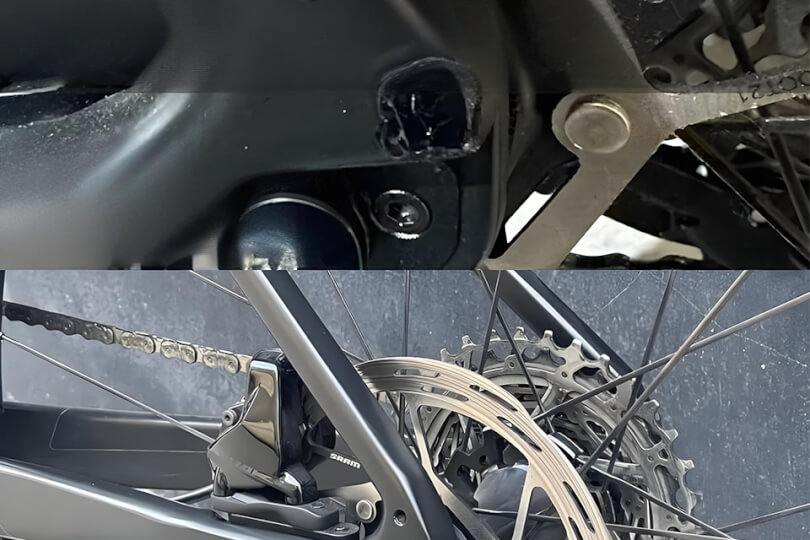
Real Repair Cases
Carbon fiber hood — surface crack after minor impact
A customer brought in a carbon fiber hood with a 120mm crack that had been incorrectly filled with body filler. The filler had already cracked away from the repair edges. We removed the filler, prepared the substrate with proper abrasion and solvent cleaning, applied a 2-ply carbon fiber backing patch from the inner face, and refinished the outer surface with UV-resistant 2K clear coat. After curing and refinishing, the repaired area was checked for bonding quality and surface finish, and the finished surface showed no visible repair line.
Carbon fiber bike frame — misidentified as a cosmetic crack
A rider presented a road bike frame with what appeared to be a clear coat crack on the top tube. Tap testing revealed a 40mm zone of delamination extending from the crack into the tube wall. The frame had hidden structural damage from a low-speed impact. We recommended against repair and replacement with a new tube section built to the original specification. Riding on the frame in its original state would have been a safety risk.
Why Our Carbon Fiber Parts Are Less Likely to Crack
Manufacturing quality determines how a carbon fiber part performs over its service life. Parts that crack prematurely often have one or more of these issues at the manufacturing stage: insufficient fiber wet-out, voids in the laminate from inadequate consolidation, incorrect ply orientation, or UV-degraded clear coat that lets moisture into the resin matrix.
Our manufacturing process addresses each of these:
- Vacuum bagging on every part to eliminate voids and ensure full consolidation
- Aerospace-grade resin systems with verified fiber-to-resin ratios
- UV-resistant 2K clear coat that protects the resin matrix from solar degradation
- Inspection and testing options for structural components when required
- Correct fiber orientation matched to load direction for each part design
When you order a replacement part from us, you receive a part built to the same specification as the original — or better, if the original had a known weakness.
Custom Carbon Fiber Parts We Manufacture
We manufacture replacement and custom carbon fiber parts across a wide range of applications:
- Automotive: hoods, spoilers, diffusers, front lips, fenders, mirror caps
- Motorcycle: fairings, fenders, tank covers, seat cowls, exhaust heat shields
- Cycling: frame sections, forks, seat posts, aero bars
- Marine: deck panels, helm surrounds, foil components
- Aerospace and UAV: structural skins, ribs, motor mounts, fuselage sections
- Industrial: tooling, fixtures, structural brackets
All parts are manufactured using 3K or 12K carbon fiber cloth in standard or custom weave patterns, with epoxy resin systems rated for the application environment.
Contact us to discuss your repair or replacement requirement.
Can We Repair Your Carbon Fiber Part?
If you are not sure whether your carbon fiber part should be repaired or replaced, send us clear photos of the damaged area, the full part, and the back side if accessible. For structural parts, please also provide the part application, load direction, and whether the part is safety-critical.
Our team can help assess whether the damage looks cosmetic, repairable, or better suited for replacement manufacturing.
Send us photos and get an assessment
Conclusion: Repair or Replace?
Small cosmetic cracks in non-structural carbon fiber parts can be repaired effectively at home using the methods in this guide. The key requirements are correct material selection (structural epoxy, matched carbon cloth), thorough surface preparation, adequate cure time, and honest damage assessment before starting.
For structural parts with broken fibers or delamination — particularly bike frames, motorcycle structural components, and automotive safety parts — professional inspection and repair or replacement is the responsible choice. The cost of a new part is always lower than the cost of a structural failure.
If you are unsure about the damage type or repair scope, contact our team. With 28+ years in carbon fiber manufacturing, we can advise on repair feasibility, supply matched replacement parts, or manufacture a custom component to your specification.