

Carbon fiber was not invented in a single step. Joseph Swan is commonly credited with making an early carbon filament around 1860, and Thomas Edison commercialized carbonized cellulose filaments in 1879. Roger Bacon demonstrated the first high-performance carbon fibers in 1958. Akio Shindo then developed the PAN-based route in 1961 that underpins most carbon fiber made today.
That distinction matters. Swan and Edison made carbon filaments that could glow inside light bulbs. Bacon showed what near-perfect graphite filaments could do mechanically. Shindo and later researchers found practical ways to turn polymer precursors into strong, continuous reinforcement fibers.
Who discovered carbon fiber? The short answer
If “carbon fiber” means the earliest man-made carbon filament, the answer is Joseph Swan. If it means the first high-performance carbon fiber, the answer is Roger Bacon. If it means the PAN-based fiber used in most modern carbon fiber reinforced polymer (CFRP), Akio Shindo and the British Royal Aircraft Establishment were central to its development.
| Milestone | Person or organization | Why it matters |
|---|---|---|
| Around 1860 | Joseph Swan | Produced an early carbon filament for incandescent lighting |
| 1879 | Thomas Edison | Carbonized cotton thread and bamboo for practical lamp filaments |
| 1958 | Roger Bacon, Union Carbide | Demonstrated high-strength, high-modulus graphite whiskers |
| 1959 | Curry Ford and Charles Mitchell, Union Carbide | Patented high-temperature processing of rayon fibers and cloth |
| 1961 | Akio Shindo, Osaka | Made strong carbon fibers from polyacrylonitrile (PAN) |
| 1964 | William Watt and the Royal Aircraft Establishment | Developed higher-performance PAN fiber and enabled British commercialization |
| 1964 | Roger Bacon and Wesley Schalamon | Produced the first truly high-modulus commercial rayon fibers by hot stretching |
| 1970 | Toray Industries and Union Carbide | Signed a technology agreement that helped expand PAN fiber production |
Why different sources name different inventors
The disagreement comes from the definition of carbon fiber, not just from the historical record.
An all-carbon filament made for a lamp qualifies chemically as a carbon fiber. It does not have the mechanical performance expected from a structural reinforcement. Modern engineering usually uses “carbon fiber” to mean continuous fibers with high tensile strength or stiffness that can reinforce a resin matrix.
Carbon fiber and a finished carbon fiber composite are also different materials. Carbon fiber is the reinforcement. CFRP combines those fibers with a polymer matrix, often epoxy. The fibers carry much of the tensile load; the matrix binds them, transfers load between fibers, and gives the part its shape. No single inventor created that entire material system.
Joseph Swan and Thomas Edison: the carbon-filament era
Joseph Swan’s experiments with carbonized paper are commonly dated to around 1860. His goal was an incandescent lamp filament that could conduct electricity and tolerate heat in a vacuum. The material was carbon, but it was not intended to reinforce a structural component.
Thomas Edison pursued the same lighting problem in the late 1870s. The American Chemical Society notes that Edison formed cotton threads or bamboo slivers into the required shape and baked them at high temperature. Carbonization removed non-carbon elements while preserving the filament’s shape. Edison may therefore deserve credit for the first commercial carbon fiber, even though its purpose was electrical rather than structural.
These lamp filaments were important precursors. They proved that a cellulose-based material could be formed first and converted to carbon afterward. That precursor-to-carbon sequence remains part of carbon fiber production, although today’s raw materials, controls, furnaces, surface treatment, and performance targets are far more advanced.
Roger Bacon and the first high-performance carbon fibers
Roger Bacon’s 1958 discovery at Union Carbide’s Parma Technical Center began the modern high-performance era. While studying graphite under high temperature and pressure in a carbon arc, Bacon found long graphite whiskers in a solid deposit. They were thin, flexible, and far stronger and stiffer for their weight than earlier commercial carbon fibers.
According to the American Chemical Society, Bacon’s whiskers reached a tensile strength of about 20 GPa and a Young’s modulus of about 700 GPa. Those figures described exceptional laboratory filaments, not economical production fiber. Bacon estimated that making them cost about $10 million per pound at the time. The discovery established the mechanical potential of fibrous graphite, but industry still needed a scalable process.
Bacon did not make these whiskers from PAN. That is a common historical error. His U.S. Patent 2,957,756 describes filamentary graphite produced in an electric arc. PAN-based carbon fiber arrived through a separate line of research.
From rayon to commercial high-modulus fiber
Union Carbide researchers also worked with rayon, a regenerated cellulose precursor. In 1959, Curry Ford and Charles Mitchell patented a process that heat-treated rayon fibers and cloth at temperatures up to 3,000 degrees Celsius. The resulting material entered advanced composite applications in the early 1960s.
Rayon-based fiber still fell short of Bacon’s graphite whiskers in stiffness. In 1964, Bacon and Wesley Schalamon stretched carbon yarn while heating it above 2,800 degrees Celsius. The stretching aligned the graphite layers more closely with the fiber axis and increased Young’s modulus roughly tenfold. Union Carbide sold fibers based on this method under the Thornel name.
This branch of the story matters because it connects a laboratory discovery with a usable commercial product. It was not, however, the process that would dominate the global structural-fiber market.
Akio Shindo and the PAN process used today
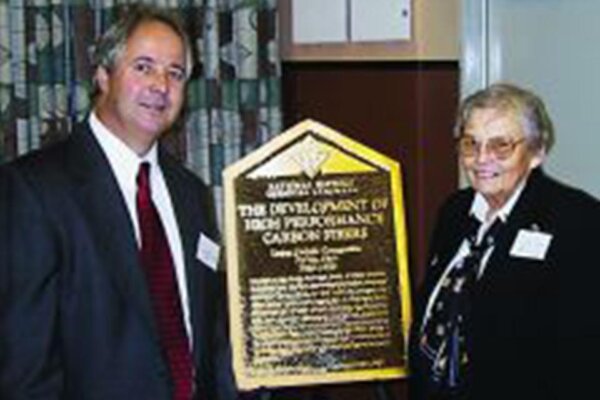
In 1961, Akio Shindo of Japan’s Government Industrial Research Institute in Osaka demonstrated high-strength, high-modulus carbon fiber made from polyacrylonitrile. The American Chemical Society reports a modulus above 140 GPa, about three times that of rayon-based fibers then available. Japanese researchers moved the process toward pilot production by 1964.
In the United Kingdom, William Watt and colleagues at the Royal Aircraft Establishment developed a still higher-performance PAN fiber in 1964. British companies licensed the technology for commercial production. Toray Industries later improved PAN precursor quality and signed a joint technology agreement with Union Carbide in 1970.
PAN became dominant because it offered a strong balance of availability, processability, carbon yield, tensile performance, and consistency. SAMPE states that about 92% of current carbon fiber production is PAN based. Pitch-derived fiber remains important where very high modulus or thermal conductivity justifies its higher cost.
How a PAN precursor becomes carbon fiber
Modern PAN-based production follows the same broad scientific sequence developed during this period:
- Spinning: A manufacturer converts PAN polymer into fine precursor filaments and draws them to orient the molecular chains.
- Stabilization: Controlled heating in air changes the polymer into a thermally stable ladder structure.
- Carbonization: Higher-temperature treatment in an inert atmosphere removes most non-carbon atoms.
- Optional higher-temperature treatment: Further heat treatment can raise modulus by increasing structural order, usually with a trade-off in other properties.
- Surface treatment and sizing: The fiber surface is prepared and coated to improve handling and bonding with the intended resin system.
The history explains why precursor selection still matters in a finished part. PAN, rayon, and pitch do not produce interchangeable fibers. Heat-treatment conditions also shift tensile strength, modulus, thermal conductivity, and cost. A designer therefore selects a fiber grade and laminate system for a load case, not simply for the label “carbon fiber.”
When did carbon fiber become a structural material?
Carbon fiber became a practical structural reinforcement during the 1960s. U.S. Air Force support helped advance rayon-based fibers for rocket nozzles, heat shields, missile components, and aircraft structures. PAN technology in Japan and the United Kingdom soon produced fibers with better performance and manufacturing potential.
Commercial adoption widened in the 1970s as fiber quality and production volume improved. Aerospace remained an early market because reducing mass could justify the material and processing cost. Sporting goods and motorsport later gave carbon composites visible consumer applications. The McLaren MP4/1, introduced in 1981, is widely associated with the first carbon-fiber-composite monocoque raced in Formula 1, but Formula 1 did not invent carbon fiber.
What this history means for carbon fiber buyers
“Carbon fiber” is a material family, not a single specification. Two black woven laminates can differ in fiber grade, tow size, weave, resin, fiber orientation, fiber volume, cure cycle, void content, and surface finish. Those variables affect stiffness, impact behavior, temperature limits, dimensional stability, appearance, and price.
For a sourcing project, define the part before choosing the process. Useful inputs include the load direction, allowable deflection, operating temperature, impact risk, target weight, surface requirement, annual volume, inspection criteria, and mating interfaces. A cosmetic cover and a load-bearing bracket may look similar but require different material systems and quality controls.
If you are evaluating a custom CFRP part, send the drawing, application, expected quantity, and performance requirements to a carbon composite manufacturer. This gives the engineering team enough context to discuss fiber architecture and molding options instead of quoting from appearance alone.
Frequently asked questions
Was carbon fiber invented in 1860 or 1958?
Both dates refer to different milestones. Around 1860, Joseph Swan made an early carbon filament for lighting. In 1958, Roger Bacon demonstrated the first high-performance graphite fibers. The 1958 discovery is the better starting point for the history of structural carbon fiber.
Did Thomas Edison invent carbon fiber?
Edison made and commercialized carbonized cellulose lamp filaments in 1879. The American Chemical Society says he may have created the first commercial carbon fiber. He did not invent the high-performance reinforcement used in modern CFRP structures.
Did Roger Bacon invent PAN-based carbon fiber?
No. Bacon discovered high-performance graphite whiskers in a carbon arc in 1958 and later helped develop high-modulus rayon fiber. Akio Shindo demonstrated a successful PAN-based process in Japan in 1961. William Watt and the Royal Aircraft Establishment advanced PAN fiber performance in 1964.
Who invented carbon fiber for Formula 1?
No Formula 1 team invented the fiber itself. McLaren introduced the MP4/1 carbon-composite monocoque in 1981, working with Hercules Aerospace on the composite structure. That was a major motorsport application of existing carbon fiber technology.
What is the difference between carbon fiber and CFRP?
Carbon fiber is the reinforcing filament. CFRP is a composite in which carbon fibers are embedded in a polymer matrix, commonly epoxy. Fiber type and orientation govern much of the directional stiffness and strength, while the matrix binds the fibers, transfers load, and defines the part’s form.
About the author
Technical review by Hank, Product Manager