Carbon fiber and Kevlar are both high-performance composite materials, but they are built for different jobs. Carbon fiber is selected when a part needs high stiffness, low weight, dimensional stability and a premium visible finish. Kevlar is selected when a part needs impact resistance, abrasion resistance, toughness and energy absorption.
For many real-world parts, the best solution is neither material alone. A carbon Kevlar hybrid composite combines the stiffness of carbon fiber with the damage tolerance of Kevlar — making it the standard choice for motorcycle fairings, racing panels, skid plates, protective shells and marine impact zones.
This guide compares carbon fiber vs Kevlar, carbon Kevlar vs carbon fiber, and all three against fiberglass — from both a materials and a manufacturing point of view.
Quick Answer
| If your priority is… | Choose… |
|---|---|
| Stiffness, low weight, premium appearance | Carbon fiber |
| Impact resistance, abrasion, energy absorption | Kevlar |
| Both stiffness and damage tolerance | Carbon Kevlar hybrid |
| Lower cost, general composite performance | Fiberglass |
Full Comparison Table: Carbon Fiber vs Kevlar vs Carbon Kevlar
Typical values — actual performance depends on fiber grade, resin system, layup schedule and curing process.
| Property | Carbon Fiber (CFRP) | Kevlar / Aramid | Carbon Kevlar Hybrid |
|---|---|---|---|
| Main Advantage | Stiffness and low weight | Impact and abrasion resistance | Balance of stiffness and toughness |
| Density (typical) | 1.55–1.80 g/cm³ | ~1.44 g/cm³ | ~1.50–1.65 g/cm³ |
| Tensile Strength (typical fiber) | 3,500–7,000 MPa depending on grade | 3,000–3,600 MPa depending on grade | Depends on layup ratio |
| Stiffness / Young’s Modulus | High — much stiffer than Kevlar | Significantly lower than carbon fiber | Medium to high |
| Elongation at Break | Low — brittle failure | Higher — better energy absorption | Medium |
| Impact Resistance | Moderate — can crack under sharp impact | Excellent | Better than pure carbon fiber |
| Abrasion Resistance | Moderate | Excellent | Good to excellent |
| Compression Strength | Good | Weaker — tends to buckle | Depends on layer design |
| UV Resistance | Good with resin / clearcoat protection | Poor — degrades without UV protection | Needs resin / coating protection |
| Heat Resistance | Fiber is heat stable; finished composite depends on resin Tg — high-temp epoxy required for heat applications | Fiber is heat resistant; composite is limited by resin system | Same — limited by resin |
| Moisture Resistance | Good with suitable epoxy | Higher moisture absorption, especially at unsealed edges | Depends on resin and edge sealing |
| Machinability | Easier to trim, drill and CNC | Difficult — fibers fuzz at cut edges | Harder than pure carbon fiber |
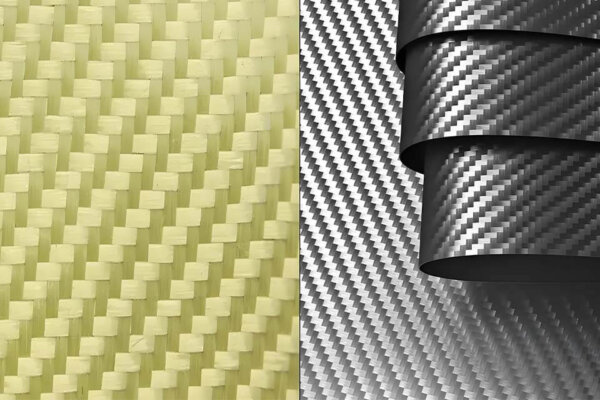
| Appearance | Black woven, forged or UD carbon finish | Yellow / gold aramid weave | Black and gold hybrid weave |
| Relative Cost | High | High | Higher than either alone |
| Best Use | Structural, cosmetic and lightweight parts | Protective, impact and abrasion zones | Motorsport, motorcycle, marine, protective shells |
What Is Carbon Fiber?
Carbon fiber is made from very thin filaments of carbon atoms, typically 5 to 10 micrometers in diameter. The fibers are produced from a precursor material — most commonly polyacrylonitrile (PAN) — through a multi-stage heat treatment process that removes everything except carbon. The result is a fiber where carbon atoms are tightly bonded along the fiber axis, which is why carbon fiber is so stiff in the fiber direction.
In practice, carbon fiber is never used as dry fiber alone. It is combined with resin — usually epoxy — to form carbon fiber reinforced polymer (CFRP). The laminate properties depend on fiber grade, fabric style, resin system, fiber volume fraction and curing process.
Carbon Fiber Grades — What the Numbers Mean
Different grades are optimized for different performance targets:
| Grade Type | Tensile Strength (typical) | Modulus (typical) | Common Use |
|---|---|---|---|
| Standard modulus (e.g. T300 type) | ~3,500 MPa | ~230 GPa | General structural parts, body panels |
| Intermediate modulus (e.g. T700/T800 type) | ~4,900–5,600 MPa | ~230–294 GPa | Aerospace, high-performance racing |
| High modulus (e.g. M40 type) | ~4,400 MPa | ~392 GPa | Stiffness-critical aerospace and robotics |
| Ultra-high modulus (e.g. M60 type) | ~3,800 MPa | ~588 GPa | Precision instruments, satellite structures |
Note: as modulus increases, elongation decreases — higher modulus fibers are also more brittle. Standard and intermediate modulus grades are used for most automotive and motorcycle composite parts.
Why Carbon Fiber Can Crack Under Impact
Carbon fiber’s brittleness under out-of-plane impact is a real design constraint. When a CFRP panel is hit by a concentrated load — a stone strike, a crash, a dropped tool — it does not dent like metal. It cracks or delaminates. This is precisely why Kevlar inner layers or hybrid layups are used in impact-prone zones, even on carbon fiber-dominant parts.
What Is Kevlar?
Kevlar is a para-aramid synthetic fiber, trademarked by DuPont and first used commercially in the early 1970s. In composite manufacturing, “Kevlar” is often used as a general term for aramid fiber reinforcement, though different grades exist for different applications.
The key property that distinguishes Kevlar from carbon fiber is elongation before break. Where standard carbon fiber breaks at around 1.5–1.9% elongation, Kevlar grades can reach 2.4–4.0% before failure. This means Kevlar absorbs and dissipates energy through fiber tensile deformation rather than brittle fracture — which is why it performs so well in ballistic protection and impact applications.
Kevlar Grades — Main Types
| Grade | Main Use | Characteristic |
|---|---|---|
| Kevlar 29 | Body armor, ropes, protective clothing | Maximum toughness, lower modulus |
| Kevlar 49 | Composite structures, marine, aerospace | Higher modulus, widely used in rigid composites |
| Kevlar 149 | Stiffness-critical composites | Highest modulus Kevlar grade |
| Kevlar KM2+ | Ballistic armor panels | Optimized for energy absorption |
For rigid composite parts — boat hulls, fairings, protective panels — Kevlar 49 is the most commonly used grade.
Key Limitation: Kevlar Under Compression
Kevlar performs poorly under compressive loads. Unlike carbon fiber, where the fiber structure resists both tension and compression, aramid fibers buckle under compression. This makes Kevlar unsuitable as the sole structural fiber in load-bearing beams, chassis rails or stiffness-critical structures. When stiffness is a design requirement, carbon fiber must be included in the laminate.
What Is Carbon Kevlar?
Carbon Kevlar is not a single fiber. It is a hybrid composite design that combines carbon fiber and Kevlar (aramid) in the same laminate or fabric. The two fibers can be combined in several ways:
- Woven hybrid fabric: Carbon and Kevlar tows are woven together in the same fabric, producing the distinctive black-and-gold pattern
- Layered laminate: Separate plies of carbon fiber and Kevlar are stacked in a designed sequence — each material placed where its properties are most needed
- Local reinforcement: Carbon fiber forms the primary structure; Kevlar is added only in specific impact zones
Why Engineers Use Carbon Kevlar
Carbon fiber and Kevlar each solve one problem but create another:
- Pure carbon fiber → stiff and light, but cracks under sharp impact
- Pure Kevlar → excellent toughness, but poor stiffness and hard to finish
Carbon Kevlar captures carbon fiber’s compressive strength and stiffness, and Kevlar’s impact resistance and damage tolerance — the ability to hold together after local failure rather than failing catastrophically.
This property is why carbon Kevlar is standard in:
- Motorcycle fairings (especially inner layers and crash-prone panels)
- Racing car body panels and monocoques
- Marine hulls in bow and keel impact zones
- Protective structural panels
- Skid plates and underbody guards
- Rally and off-road composite parts
- High-end luggage, drone frames, industrial guards
Typical Carbon Kevlar Layup Strategy
The most common professional approach:
| Layer | Material | Purpose |
|---|---|---|
| Outer face | 1–2 plies carbon fiber | Stiffness, surface quality, cosmetic finish |
| Inner face | 1–2 plies Kevlar | Impact absorption, damage containment |
| Core (if needed) | Foam or honeycomb | Add stiffness with minimum weight |
This layup is harder to trim than pure carbon fiber — the Kevlar inner ply fuzzes at the cut edge and requires sealing or binding. This is a real manufacturing consideration that should factor into your material choice.
Strength Comparison: Carbon Fiber vs Kevlar
“Strength” is not one number. Carbon fiber and Kevlar are each stronger than the other under different loading conditions.
Tensile Strength
Both materials have high tensile strength. Typical intermediate-modulus carbon fiber in a composite reaches significantly higher tensile strength values than Kevlar 49 in comparable configurations — but in real part design, raw tensile strength along the fiber axis is rarely the only load case.
Part performance also depends on fiber direction, layup schedule, resin system, fiber volume fraction, part geometry and load direction. A poorly designed carbon fiber laminate can fail before a well-designed hybrid laminate.
Stiffness (Young’s Modulus)
Carbon fiber is significantly stiffer than Kevlar. This is the main reason carbon fiber is used in aerospace, motorsport, robotic arms, precision instruments and high-performance automotive parts.
A structural panel made from carbon fiber will deflect roughly half as much as the same panel made from Kevlar under the same load. For applications where shape must be maintained precisely — aerodynamic surfaces, wing elements, optical mounts — stiffness is usually the governing requirement and carbon fiber is the correct choice.
Compression Strength
Carbon fiber composites perform well in compression. Kevlar composites perform poorly — the fibers buckle rather than resist the load. This is the most important reason Kevlar is not used as the sole structural fiber in load-bearing compression members.
For structural beams, chassis rails, tubes and compression-dominated parts: carbon fiber is the correct material.
Impact Resistance
This is where Kevlar has a decisive advantage. In impact and fracture-toughness testing, Kevlar laminates can absorb significantly more energy per unit weight than standard carbon fiber laminates before failure. Kevlar fibers stretch and pull rather than fracturing suddenly — which is why Kevlar composite panels tend to dent and deform under impact while carbon fiber panels crack and shatter.
For ballistic and blast applications: Kevlar is the baseline material. Carbon fiber does not perform comparably in ballistic testing and generates dangerous sharp fragments on failure.
Abrasion Resistance
Kevlar outperforms carbon fiber significantly in abrasion. The fibrous, high-tenacity nature of Kevlar makes it resistant to scraping, sliding wear and surface abrasion — which is why it is used in motorcycle riding gear, industrial gloves, skid plates and underbody protection panels.
Kevlar vs Carbon Fiber: Weight
| Material | Typical Density |
|---|---|
| Carbon fiber composite (CFRP) | 1.55–1.80 g/cm³ |
| Kevlar composite (AFRP) | 1.35–1.45 g/cm³ |
| Carbon Kevlar hybrid | ~1.50–1.65 g/cm³ |
| Aluminium 6061 | 2.70 g/cm³ |
| Structural steel | 7.85 g/cm³ |
Kevlar fiber has a slightly lower density than carbon fiber, so Kevlar is marginally lighter by volume. However, finished part weight depends on the full laminate design, not fiber density alone.
Because Kevlar is less stiff than carbon fiber, a Kevlar part designed to match the stiffness of a carbon fiber part needs more material thickness — which increases its weight. In stiffness-critical applications, carbon fiber parts typically end up lighter than equivalent Kevlar parts, because less thickness is needed to meet the stiffness target.
The better question is not “which fiber is lighter?” but “which laminate achieves the required performance at the lowest total weight?” The answer depends on whether your design is stiffness-governed or impact-governed.
Carbon Fiber vs Kevlar: Cost
Both materials are in the premium composite category. Neither is close to fiberglass in cost.
| Material | Raw Fiber Cost (approximate) | Key Cost Driver |
|---|---|---|
| Standard carbon fiber (T300/T700) | $15–25 / kg | Fiber production, autoclave processing |
| High-modulus carbon fiber | $80–300+ / kg | Specialized fiber grades |
| Kevlar 49 | $20–35 / kg | Fiber production, harder post-processing |
| Carbon Kevlar hybrid fabric | $30–60 / kg | Combined fiber cost |
| E-glass fiberglass | $2–5 / kg | Widely available, simple production |
Is Kevlar Cheaper Than Carbon Fiber?
For standard grades, raw material costs are broadly similar. The difference in finished part cost comes from:
- Processing: Carbon fiber prepreg with autoclave processing adds significant cost versus wet layup or infusion. Kevlar is more commonly processed by wet layup or vacuum infusion, which can reduce process cost but not always total part cost.
- Machining: Kevlar is harder to trim, drill and finish cleanly. Labor time is higher than for equivalent carbon fiber parts.
- Waste and rework: Kevlar edge finishing requires more time and care, increasing per-part labor cost.
Bottom line for purchasing decisions: For rigid structural composite parts, expect carbon fiber and Kevlar to cost similarly — the fiber cost difference is smaller than the manufacturing cost difference. Carbon Kevlar hybrid parts typically cost more than either material alone due to added manufacturing complexity.
Heat, UV and Moisture: Carbon Fiber vs Kevlar
Heat Resistance
The critical point: heat resistance of any finished composite part is limited primarily by the resin system, not the fiber. Both carbon fiber and Kevlar fibers can withstand far higher temperatures than standard epoxy resins.
A standard epoxy laminate typically operates continuously up to 120–150°C. For applications near engines, exhausts, brakes or industrial heat sources, a suitable high-temperature epoxy or resin system must be specified — choosing carbon fiber or Kevlar fiber alone does not make a part heat-resistant.
If your application involves elevated temperatures, the first question to ask is: what is the required service temperature, and what resin system is specified?
UV Resistance
This is Kevlar’s most significant weakness. Aramid fibers degrade under ultraviolet light. Without UV protection, Kevlar composite surfaces will lose strength, yellow and break down over time with outdoor exposure.
Carbon fiber composites are significantly more UV-stable. The resin surface still benefits from a UV-blocking clearcoat or paint, but the carbon fiber itself is essentially inert to UV.
For any outdoor application — automotive bodywork, motorcycle fairings, marine parts — Kevlar or carbon Kevlar panels must be protected with a UV-stable resin surface, paint or clearcoat. This is not optional.
Moisture Resistance
Carbon fiber composites absorb very little moisture with a good epoxy resin system. Kevlar composites can absorb more moisture, particularly at unsealed cut edges and drilled holes. Moisture uptake gradually reduces the glass transition temperature (Tg) of the resin matrix and can reduce mechanical properties under sustained wet conditions.
For marine parts, outdoor structures and high-humidity industrial applications: edge sealing, careful resin selection and a barrier coating are important for Kevlar or carbon Kevlar parts.
Carbon Kevlar vs Carbon Fiber: When to Choose the Hybrid
This is one of the most searched comparisons in this topic — and one that most articles answer poorly.
Choose carbon Kevlar over pure carbon fiber when:
- The part has a clearly identified impact zone where carbon fiber alone would crack or shatter
- You need damage tolerance — the part must stay intact after local damage rather than failing catastrophically
- The application is a motorcycle fairing, racing skid plate, marine hull, crash panel, rally bodywork or protective shell
- The distinctive black-and-gold hybrid weave appearance is part of the design intent
Stay with pure carbon fiber when:
- Stiffness and dimensional stability are the primary design requirements
- Surface finish quality is critical — Kevlar’s yellow fiber can show through thin carbon layers
- Compressive loading is a primary load case
- The part requires clean CNC machining to tight tolerances
- Weight is absolutely critical and impact risk is low (aerospace structural parts, precision instruments)
- You want the cleanest possible black carbon surface finish
What to Expect from Carbon Kevlar Manufacturing
Parts with carbon Kevlar hybrid layups:
- Cannot be CNC trimmed as cleanly as pure carbon fiber — the Kevlar ply fuzzes at cut edges
- Require edge sealing, binding tape or extra resin at trimmed edges
- Take more time to finish than equivalent carbon fiber parts
- May show a slight surface texture difference if the Kevlar layer is near the outer face
These are real considerations. A carbon Kevlar part is not simply a carbon fiber part with better properties — it requires more manufacturing attention.
Applications: Carbon Fiber vs Kevlar by Industry
Automotive Parts
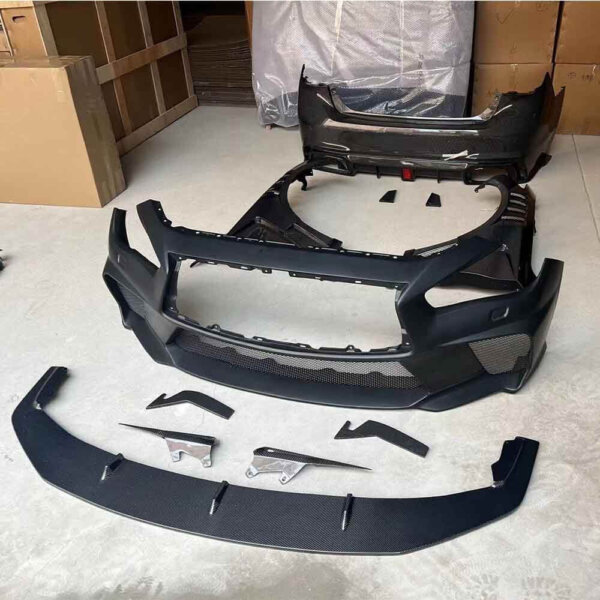
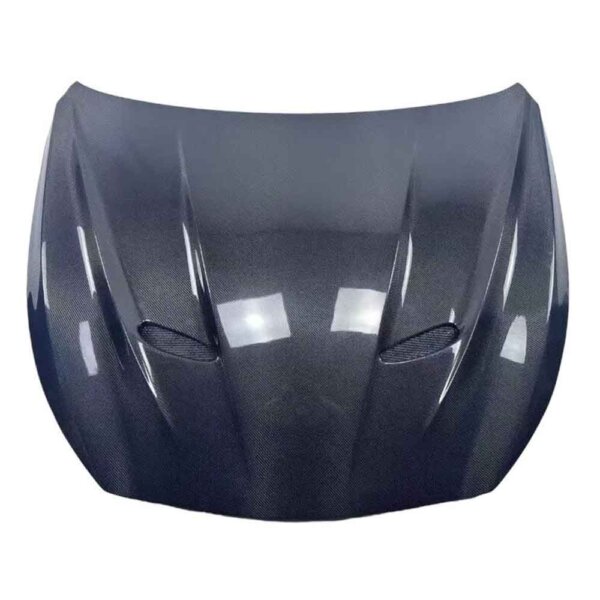
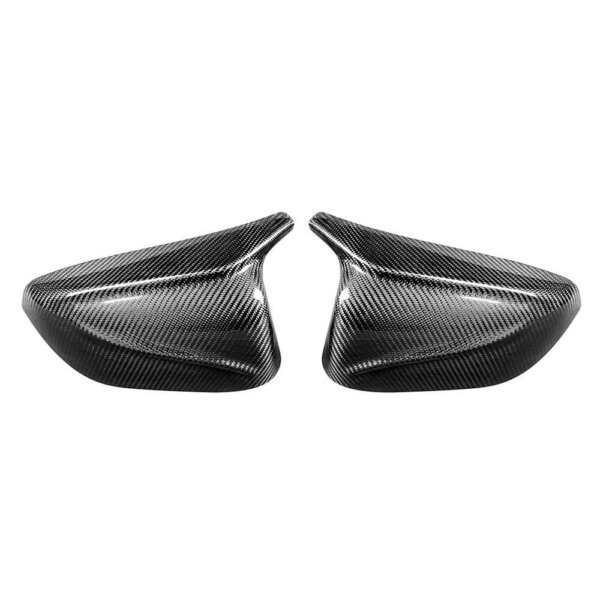
Carbon fiber is the standard choice for automotive body kits, hoods, roofs, diffusers, spoilers, splitters, mirror caps and interior trim where stiffness, weight reduction and premium appearance are the requirements.
Kevlar or carbon Kevlar is used where impact tolerance is a priority:
- Underbody panels and skid plates
- Floor and firewall reinforcement in racing applications
- Inner layers of crash-prone panels
- Rally parts and protective covers
A common approach: carbon fiber visible outer surface + Kevlar reinforcement on the underside of a splitter or underbody panel, improving impact tolerance without changing the exterior appearance.
Motorcycle Parts
Carbon fiber is used for fairings, tail sections, tank covers, fenders, huggers and race bodywork — combining weight reduction with premium finish.
Kevlar or carbon Kevlar is used for:
- Inner fairing reinforcement layers in racing applications
- Crash-prone panel areas where a first impact should not destroy the part
- Belly pans, skid plates and protective underbody covers
A well-designed racing fairing may use visible carbon fiber on the outer face and a Kevlar inner ply on areas most likely to contact the ground in a lowside crash. The Kevlar layer holds the fairing together after the carbon outer layer cracks, keeping fragments away from the rider and engine.
Marine Parts
Kevlar is widely used in performance canoes and kayaks where rock impact and abrasion resistance matter more than ultimate stiffness. A Kevlar hull flexes and rebounds; a carbon fiber hull of equivalent weight would crack.
Carbon fiber is preferred for:
- Racing hull structural skins
- Sailing mast sections
- Hydrofoil arms and foil structures
- Stiffness-critical marine components
Carbon Kevlar hybrids are common in performance cruising hulls and multihull structures — stiff in normal sailing conditions but tough enough to survive grounding or collision.
Industrial and Robotic Parts
Carbon fiber is the standard for robotic arms, machine covers, lightweight inspection equipment, precision frames and automation components where stiffness and weight reduction are the performance drivers.
Kevlar or carbon Kevlar is used for:
- Protective machine guards and industrial shells
- Abrasion-resistant covers
- Impact shields and safety panels
- Industrial inspection and survey equipment that may be dropped or subject to rough handling
Aerospace and Drone Parts
Carbon fiber dominates aerospace composite applications because stiffness-to-weight ratio is the primary performance requirement. Drone arms, UAV frames, aerospace brackets, satellite panels and structural skins are almost always carbon fiber.
Kevlar may be used in selected aerospace areas where penetration resistance or impact tolerance is needed — for example, underbelly protection, engine containment rings or ballistic threat zones — but it is not the standard structural material.
For consumer and commercial drones: carbon fiber is usually the correct choice for frame stiffness and flight stability. Kevlar or carbon Kevlar may be considered for crash-prone frame sections, with the trade-off that stiffness will be somewhat lower than an equivalent all-carbon design.
Protective Equipment
Kevlar is the defining material for ballistic protection — bullet-resistant vests, helmet shells, vehicle armor panels. Its energy absorption mechanism (fiber tensile failure across many layers) is effective for stopping projectiles.
For structural protective panels — helmet outer shells, shin guards, industrial protective covers — a carbon outer / Kevlar inner design is common. Carbon provides shape and stiffness; Kevlar absorbs impact and prevents sharp carbon fragments from reaching the wearer.
Note: no single material is “bulletproof” on its own. Ballistic protection requires a certified system with the correct material combination, layer count and construction standard.
Sports Equipment
Carbon fiber pickleball paddles and racket sports equipment provide stiff response, low weight and a crisp feel — preferred by players prioritizing power and control.
Kevlar paddles offer better shock absorption, softer feel and vibration damping — preferred by players prioritizing touch and arm comfort.
Most high-performance paddles use hybrid constructions combining both materials, with carbon fiber providing structure and Kevlar in high-wear or high-impact zones.
Carbon Fiber vs Kevlar vs Fiberglass
| Material | Tensile Strength (typical fiber) | Young’s Modulus | Density | Impact Resistance | Relative Cost |
|---|---|---|---|---|---|
| Carbon fiber | 3,500–7,000 MPa | 200–800 GPa | 1.75 g/cm³ | Moderate | High |
| Kevlar 49 | ~3,000 MPa | ~125 GPa | 1.44 g/cm³ | Excellent | High |
| E-glass fiberglass | ~2,000–3,450 MPa | ~70–85 GPa | 2.58 g/cm³ | Good | Low |
Fiberglass is significantly heavier than carbon fiber or Kevlar, but it is 5–10× cheaper per kilogram and performs well for general composite applications where weight reduction is not the primary requirement.
Choose fiberglass when:
- Cost is a primary constraint
- The part does not require extreme stiffness or weight reduction
- UV, moisture and chemical resistance are important without paying a premium
- The part is large and weight saving does not justify the cost of carbon fiber
One-line summary:
Carbon fiber for stiffness and weight. Kevlar for toughness and protection. Fiberglass for cost and general durability. Carbon Kevlar when stiffness and toughness are both required.
Manufacturing Differences: What Matters for Part Production
The following reflects direct manufacturing experience. Material choice affects every step of the process — not only the finished part properties.
Cutting and Trimming
Carbon fiber cuts cleanly with carbide router bits, diamond-coated tools or water jet cutting. CNC trimming is straightforward with proper dust extraction. Cut edges are clean and can be sanded smooth.
Kevlar resists cutting. The high-tenacity fibers do not sever cleanly — they deflect around the tool and fuzz at the edge. Effective cutting requires sharp serrated shears for dry fabric, and carbide or ceramic router bits for cured laminates. Waterjet cutting is often the cleanest method for production volumes.
Carbon Kevlar hybrid inherits Kevlar’s cutting difficulty. Allow additional trimming and edge finishing time versus an equivalent carbon fiber part.
CNC Machining
Carbon fiber composite plates can be CNC machined — hole drilling, edge routing, slot cutting — with correct carbide tooling and dust extraction. Kevlar-containing laminates are significantly harder to machine cleanly. For precision CNC carbon fiber plates, pure carbon fiber laminate is easier to control than any Kevlar hybrid.
Surface Finish
Carbon fiber’s gloss or matte black woven surface with clearcoat is a premium finish achievable with standard composite manufacturing practice.
Kevlar and carbon Kevlar require more care. Aramid fibers do not sand as cleanly as carbon fiber. The yellow Kevlar fibers can show through thin resin layers or become visible at sanded edges. For parts where a uniform high-gloss black surface is required, carbon fiber outer plies are necessary — Kevlar should remain as an inner structural or reinforcement layer.
Resin Compatibility and Process Selection
Both carbon fiber and Kevlar are compatible with epoxy resin systems. Epoxy is strongly preferred for structural composite parts — it provides better adhesion, lower void content and more consistent mechanical properties than polyester or vinyl ester.
| Process | Carbon Fiber | Kevlar | Carbon Kevlar |
|---|---|---|---|
| Prepreg + autoclave | Standard for premium parts | Possible | Used in motorsport inner liners |
| Vacuum infusion | Common for larger parts | Common | Common |
| Wet layup | Low-cost option | Marine, armor applications | Marine |
| Compression molding | High-volume automotive | Difficult due to cutting | Difficult |
| CNC post-machining | Clean | Difficult — fuzzing | Difficult |
For autoclave prepreg carbon fiber parts, fiber volume fractions of 60%+ and void contents below 1% are achievable, which corresponds to the mechanical properties listed in the tables above. Vacuum infusion typically achieves 45–55% fiber volume at correspondingly good but somewhat lower properties.
Which Material Should You Choose?
| Your requirement | Best choice |
|---|---|
| Maximum stiffness, lowest weight | Carbon fiber |
| Premium black carbon appearance | Carbon fiber |
| Shape precision / dimensional stability | Carbon fiber |
| Impact resistance, energy absorption | Kevlar |
| Abrasion and wear resistance | Kevlar |
| Ballistic and penetration protection | Kevlar-based system |
| Stiffness + impact tolerance combined | Carbon Kevlar hybrid |
| Racing / motorcycle / marine crash zones | Carbon Kevlar hybrid |
| Large parts on a budget | Fiberglass |
| Cost-performance balance for general use | Fiberglass or glass/carbon hybrid |
Practical Hybrid Design Strategy
For many custom composite projects, the best solution is a designed hybrid laminate rather than one material throughout. Common factory approaches:
- Visible automotive part: carbon fiber outer + fiberglass inner (cost control with premium finish)
- Racing fairing: carbon fiber outer + Kevlar inner (weight with crash tolerance)
- Skid plate: carbon fiber structural layers + Kevlar abrasion layer on wear face
- Marine hull: carbon fiber structural skin + Kevlar in bow impact zone
- Industrial cover: fiberglass for cost control + local carbon fiber reinforcement at high-stress mounting areas
To specify the right laminate for your part, the following information helps most when submitting a custom carbon fiber inquiry:
- STEP / STP file or 2D drawing with dimensions
- Required wall thickness or weight target
- Load type (structural, cosmetic, protective)
- Heat and UV exposure conditions
- Mounting method and insert requirements
- Surface finish requirement
- Production quantity
FAQ: Carbon Fiber vs Kevlar
Is Kevlar stronger than carbon fiber?
It depends on the type of strength. In impact resistance, toughness and abrasion resistance, Kevlar performs better. In stiffness, compressive strength and tensile strength per unit area, carbon fiber is typically stronger. Neither material is simply “stronger” — they fail differently under different loading conditions.
Is carbon fiber stronger than Kevlar?
In stiffness and compressive loading, yes. Intermediate-modulus carbon fiber has higher tensile strength values than Kevlar 49 in standard composite form, and much higher modulus. But carbon fiber’s brittle failure mode means it can crack without warning under sharp impact — where Kevlar deforms and absorbs energy instead.
Is Kevlar lighter than carbon fiber?
Kevlar fiber has a slightly lower density than carbon fiber. But for stiffness-critical parts, carbon fiber panels end up lighter in practice because they need less thickness to reach the stiffness target. For impact-critical parts where stiffness is secondary, Kevlar can achieve equivalent protection at lower weight.
Is Kevlar cheaper than carbon fiber?
Raw material costs are broadly similar for standard grades. Finished part cost depends heavily on manufacturing. Kevlar parts take more time to trim, drill and finish, which increases labor cost. Carbon fiber prepreg with autoclave processing is expensive, but high-quality infused carbon parts can be cost-competitive with Kevlar.
What is carbon Kevlar?
Carbon Kevlar is a hybrid composite that combines carbon fiber and Kevlar (aramid) in the same laminate or woven fabric. It is not a single fiber — it is a material design strategy. Carbon fiber provides stiffness and shape stability; Kevlar improves impact resistance and damage tolerance. Common in motorcycle fairings, racing panels, skid plates and marine structures.
Is carbon Kevlar stronger than carbon fiber?
Not in all respects. Carbon Kevlar is more impact-resistant and damage-tolerant than pure carbon fiber. Pure carbon fiber is usually stiffer and easier to achieve a clean cosmetic finish with. Which is “stronger” depends on the load type.
Can carbon fiber and Kevlar be used together?
Yes — this is exactly what carbon Kevlar hybrid composites are. The two materials are compatible with the same epoxy resin systems and can be co-cured in a single layup. The most common approach is carbon outer ply for surface quality and stiffness, Kevlar inner ply for impact absorption and damage containment.
Why is Kevlar harder to cut than carbon fiber?
Kevlar fibers have very high tensile toughness and resist cutting by deflecting around tool edges rather than severing cleanly. This causes edge fuzzing in cured laminates and rapid wear of standard tooling. Correct cutting requires specialized tools, sharp edges and often waterjet cutting for production applications.
Does Kevlar degrade in sunlight?
Yes. Aramid fibers are degraded by ultraviolet light. Unprotected Kevlar composite surfaces will lose strength and become brittle with extended outdoor exposure. For any outdoor application, Kevlar and carbon Kevlar parts must be protected with UV-stable resin, paint or clearcoat.
Is Kevlar bulletproof? Is carbon fiber bulletproof?
Kevlar is widely used in certified ballistic protection systems, but a material alone is not bulletproof. Ballistic resistance requires a complete certified system: correct material, layer count, construction standard and test certification. Carbon fiber is not used as a primary ballistic material — its brittle failure generates dangerous sharp fragments rather than absorbing projectile energy.
Carbon fiber vs Kevlar vs fiberglass — which should I choose?
Carbon fiber for maximum stiffness and weight reduction. Kevlar for impact and abrasion resistance. Fiberglass for lower-cost composite parts where extreme performance is not required. Carbon Kevlar when stiffness and toughness are both needed. Many production parts use all three materials in different zones of the same laminate.
What files do you need to make a custom carbon fiber or Kevlar part?
A STEP / STP file or 2D drawing with overall dimensions and wall thickness. Photos of the original part or installation area are also helpful. If you have specific requirements for weight, stiffness, heat resistance or surface finish, include those in your inquiry. We will review and recommend the appropriate material and process.